The Short Answer
On our estimates, a wall-mounted split air conditioner for one room costs about £1,500 to £2,800 installed. A multi-split serving two rooms is £3,500 to £6,000, and three rooms £5,000 to £8,500. One room usually takes half a day to a day; a whole-home system two to three days.
Only use an installer with F-gas qualifications and company certification: the law requires both for anyone handling the refrigerant. A unit that heats as well as cools can be permitted development; one used only for cooling isn't covered by that right, so check with your council.
Air conditioning prices
| Item | Typical cost |
|---|---|
| One room, wall-mounted split | £1,500 to £2,800 |
| Two rooms, multi-split | £3,500 to £6,000 |
| Three rooms, multi-split | £5,000 to £8,500 |
Split or portable?
- Portable units plug into a socket and vent hot air through a hose out of a window. They're cheaper to buy and need no installer, but they're less efficient, so dearer to run. They suit renters and listed buildings where you can't make changes.
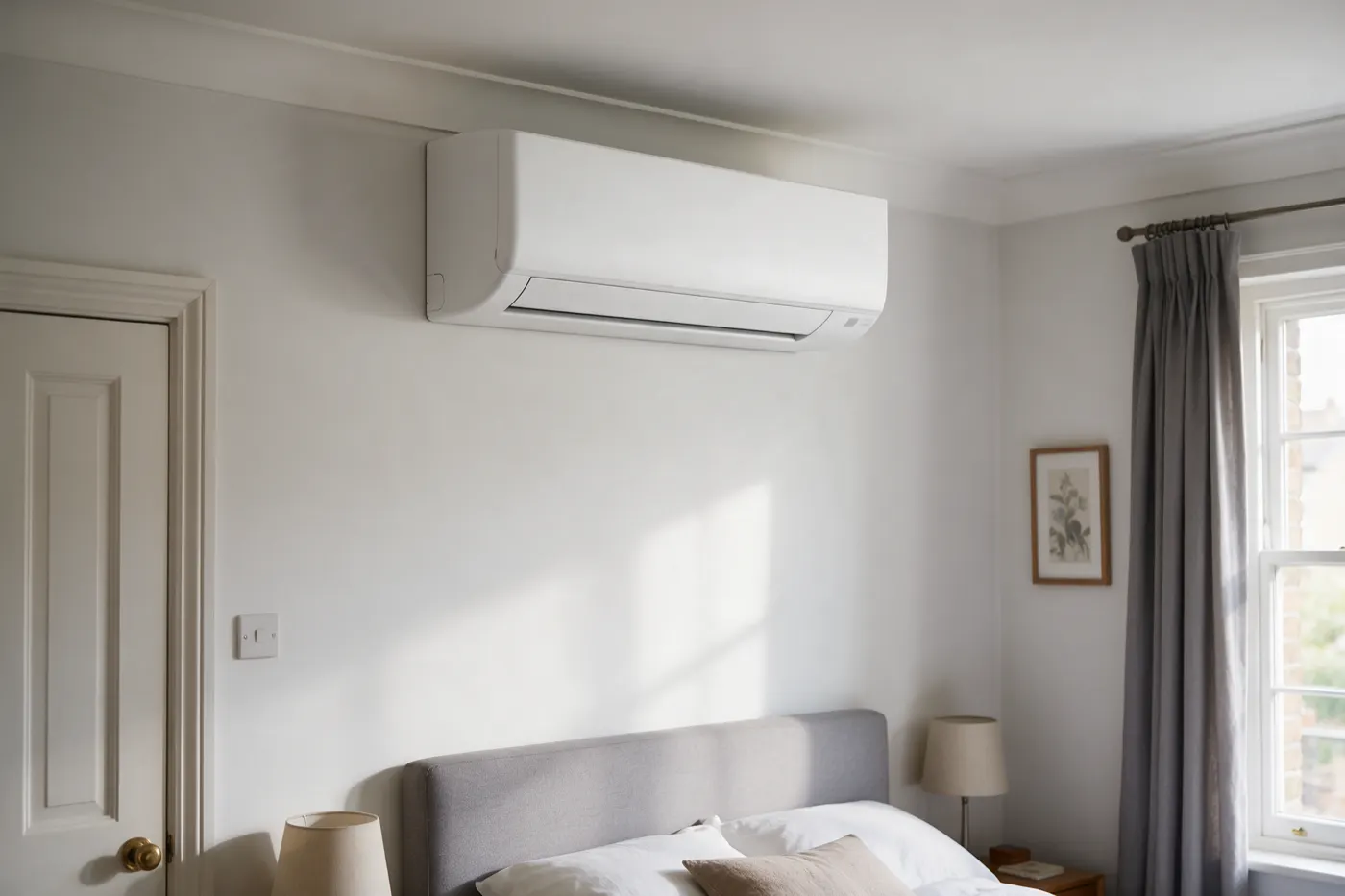
- Split systems have an indoor unit linked by pipework to an outdoor unit. They cool better, cost less to run and are quieter, but must be fitted by a professional. One outdoor unit can serve several indoor units (a multi-split).
- Ducted systems push cooled air through ducts to vents in each room. In an existing home that means invasive work, so they cost the most.
What it costs to run
Less than most people expect. Take a common 2.5kW wall unit: Eurovent's certified figures for the Daikin Perfera 2.5kW show it uses 0.56kW of electricity flat out, which is about 15p an hour at the 1 October to 31 December 2026 price cap, or £3.54 if it ran flat out for 24 hours. It doesn't run flat out all the time: at one of its certified part-load points it used about 7p an hour.
Over the EU's standard cooling season it's rated at 101 kWh a year, about £27 at today's price. Used as a heater, it's rated to give about 5.1 units of heat for every unit of electricity over a heating season. A portable unit is less efficient, so it costs more to run for the same cooling.
Is it worth it in the UK?
For a room that's unbearable every summer, like a loft bedroom or a south-facing home office, I think yes, as long as you buy a reversible unit that heats too, so it earns its keep in winter. For a hot week or two a year, a portable unit or fans make more sense than paying £1,500 to £2,800 to have a split system fitted.
Can it heat as well?
Often. Which?, quoted by BBC News, says air-to-air heat pumps are designed to heat and cool by reversing the way they move heat, but whether a unit can heat depends on the model being reversible. I'd only buy a reversible one: it's more use in a UK winter, and it matters for planning (below).
F-gas, planning and electrics
F-gas: anyone installing or servicing air conditioning must hold their own F-gas qualification, and the company must be certified. Working without them is against the law.
Planning (England): since 29 May 2025, an air source heat pump on a house can be permitted development on condition it isn't used solely for cooling. Its outdoor unit must be no bigger than 1.5m³, there are limits on how many you can have, and it can't go on a pitched roof, at a listed building, or on a wall facing the road in a conservation area. A cooling-only unit isn't covered by that right, so ask your council before you buy one.
Electrics: a new circuit for the unit is notifiable electrical work. A new circuit, a new consumer unit, or work in a bathroom's special location is notifiable: use an electrician registered with Blue Flame, Certsure (NICEIC and ELECSA), NAPIT or OFTEC, who certifies it, or tell building control. See what you should get at the end.
Get air conditioning quotes
Air conditioning is priced by the number of rooms and where the outdoor unit goes.
Free, no obligation. We're paid by MyJobQuote when a tradesperson buys your job, never by you.
Frequently asked questions
How much does it cost to install air conditioning in a house?
On our estimates, about £1,500 to £2,800 for one room with a wall-mounted split system, or £3,500 to £6,000 for two rooms.
Is it legal to install AC in the UK?
Yes. The installer must be F-gas qualified and certified. In England, a unit that also heats can be permitted development within limits; a cooling-only unit isn't covered by that right, so check with your council.
Do I need planning permission for air conditioning?
Not usually for a reversible unit (one that heats too) on a house in England, with an outdoor unit up to 1.5m³, unless it's a listed building or other limits apply. Portable units need nothing.
Is air conditioning expensive to run in the UK?
Not very. A common 2.5kW wall unit uses 0.56kW flat out on its certified figures, about 15p an hour at the current price cap, and less when it isn't working flat out. Over a standard cooling season it's rated at about £27 a year.
How much does it cost to run air conditioning 24 hours a day?
For a 2.5kW wall unit running flat out, about £3.54 a day at the current price cap. In practice it won't run flat out all day, so it should cost less.
Is it worth installing air conditioning in the UK?
For a room that overheats every summer, I'd say yes, if it's a reversible unit that heats too. For a few hot days a year, a portable unit or fans are cheaper.
Can air conditioning heat a room?
Many split systems can, if the model is reversible. Air-to-air heat pumps are built to heat and cool.
How long does air conditioning installation take?
About half a day to a day for one room, and two to three days for a whole-home multi-split.
How we priced thisView sources (8, 5 official)
Rules come from the legislation and official guidance, read at source. Prices are our estimates: we check them against trade price data, retailer shelf prices and specialists' price lists, then build them up from their parts so the totals add up. Below are the sources behind the page; the trade price guides we only compare against aren’t listed. Where sources disagreed, we've said so. More on our method.
- OfficialQualifications to work with F gas; Company certification to work with F gas, GOV.UK. Checked 15 Oct 2026.
- OfficialThe Town and Country Planning (General Permitted Development) (England) Order 2015, Schedule 2 Part 14 (renewable energy), legislation.gov.uk. Checked 16 Oct 2026.
- OfficialThe Building Regulations 2010, regulation 12(6A) and (9): notifiable electrical work and 'special location' (England), legislation.gov.uk. Checked 14 Oct 2026.
- OfficialThe Building Regulations 2010, Schedule 3: self-certification schemes (para 16, roof coverings), legislation.gov.uk. Checked 15 Oct 2026.
- IndustryModel RXM25R9 / FTXM25R (air-to-air split, reversible): certified performance data, Eurovent Certita Certification. Checked 16 Oct 2026.
- OfficialEnergy price cap unit rates and standing charges, 1 October to 31 December 2026, Ofgem. Checked 15 Oct 2026.
- IndustryHow can I get air conditioning in my home and how much does it cost?, BBC News. Checked 16 Oct 2026.
- IndustryAir conditioning installation cost: what to expect, OVO. Checked 16 Oct 2026.