The Short Answer
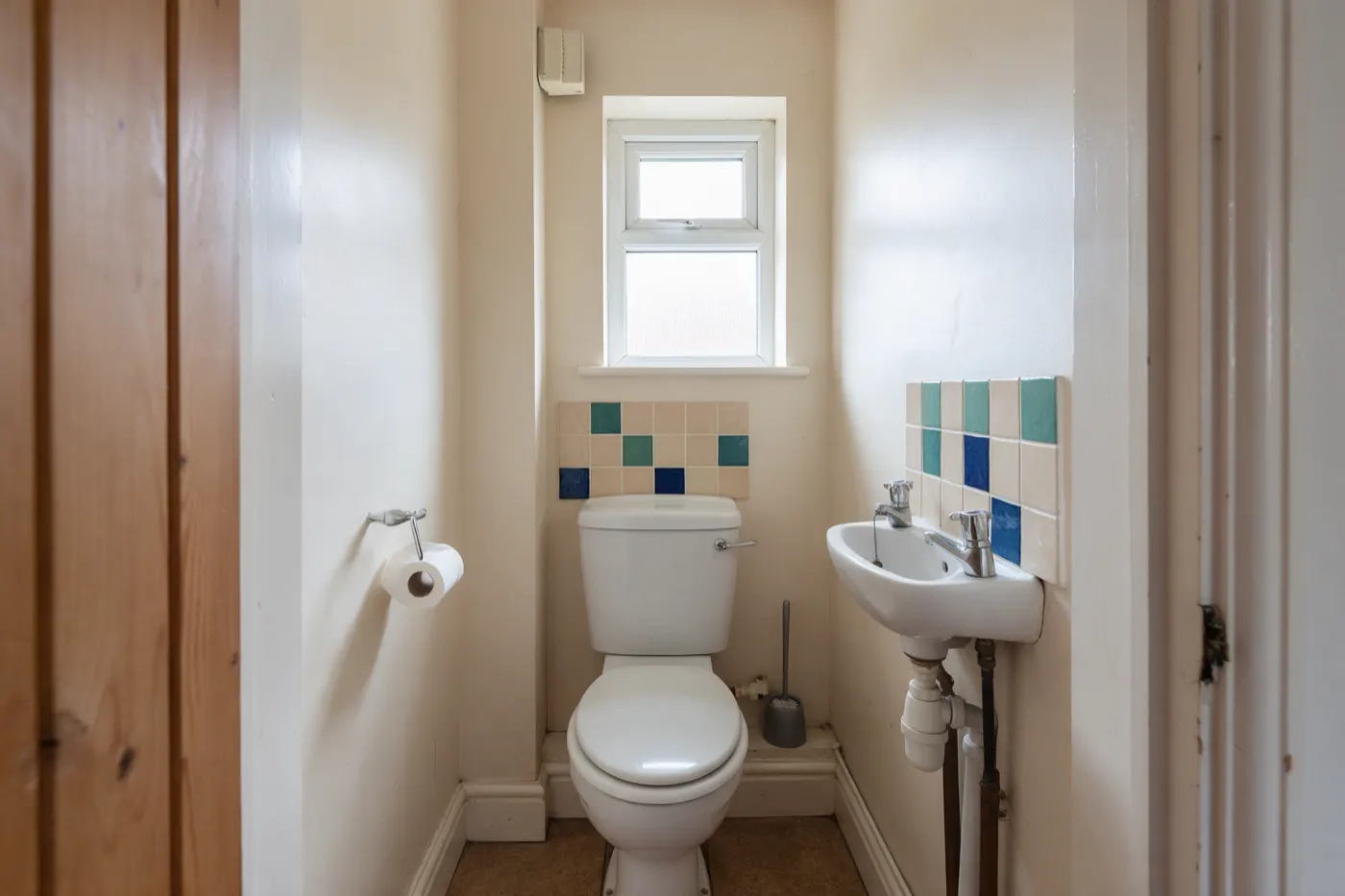
A downstairs toilet and basin in an existing space, such as under the stairs, costs about £2,200 to £4,500 when it can drain by gravity, by our estimate, and takes one to two weeks. Luxury finishes or concealed plumbing can take it to around £6,000.
Drainage decides what's possible. A toilet's waste pipe must fall at least 18mm for every metre it runs, and a pumped (macerator) toilet is only allowed if there's also an ordinary one in the house.
Can I fit a downstairs toilet here?
Drainage decides almost everything. This checks your space against the Building Regulations limits and prices the route that works.
Good news: an ordinary gravity toilet should work.
A 100mm pipe needs at least 54mm of fall over 3m, and can run up to 15m without extra venting.
Estimated total
£3,150 to £6,900
| Toilet, basin, plumbing and drainage to the stack (gravity) | £2,200 to £4,500 |
| Extractor fan and background vent (Part F) | £250 to £600 |
| Stud walls, door and lining | £700 to £1,800 |
Downstairs toilet prices
| Job | Our estimate |
|---|---|
| Toilet and basin in an existing space, gravity drainage | £2,200 to £4,500 |
| Toilet and basin on a macerator | £1,800 to £3,500 |
| Stud walls, door and lining | £700 to £1,800 |
| Extract fan and background vent | £250 to £600 |
| New drain run (breaking out the floor) | £600 to £1,800 |
| Small extension, per m² before fit-out | £1,900 to £2,500 |
Two costs people forget: connecting to the drains is often the dearest single item (£600 to £1,800 on our estimates where new underground connections are needed), and building control fees are about £400 if the work isn't covered by a registered installer.
Drainage: the 18mm rule
Approved Document H sets the limits. A WC with a standard outlet needs a 100mm pipe falling between 18mm and 90mm per metre, on an unventilated branch of up to 15 metres. A basin on a 32mm waste can run about 1.7 metres (3 metres on 40mm, 4 on 50mm).
| Distance to the connection | Minimum fall |
|---|---|
| 2 metres | 36mm |
| 4 metres | 72mm |
| 6 metres | 108mm |
| 10 metres | 180mm |
The closer the new toilet is to the existing plumbing, the cheaper and easier it is.
Macerators: when they're allowed
A macerator uses a pump and blades to break down waste and pump it away. Approved Document G (paragraph 4.25) only allows one where there is also access to a WC that drains by gravity, and the unit meets BS EN 12050-1: it can't be the only toilet in the house.
Saniflo, the best-known maker, says to flush only human waste and toilet paper (no wipes or sanitary products), not to use strong drain cleaners or in-bowl rim blocks, and to descale it with its descaler, especially in hard water. My view: a good fix for an awkward second toilet, not a first choice.
The other rules
- Building regulations. The Planning Portal says a new toilet where there wasn't one is likely to need approval, for drainage and ventilation among other things.
- A door, not a lobby. Approved Document G says a room with a toilet must be separated by a door from anywhere food is prepared; in a home, a room with both a toilet and a basin doesn't need a separate lobby, so it can open off a kitchen if it has a door.
- Ventilation. Approved Document F asks for an extract fan of at least 6 litres a second plus a background ventilator, or continuous extract; in a toilet-only room, a window meeting the purge ventilation guidance can do instead of the fan. With no window that opens, the fan should run on for at least 15 minutes. Humidity-controlled fans aren't for toilet-only rooms, where smell is the problem.
- Homes built after 1999 already have a ground-floor toilet designed for visiting wheelchair users: don't make it less accessible.
Get downstairs toilet quotes
Whether a downstairs loo is easy or awkward comes down to drainage. These questions tell the plumber which.
Free, no obligation. We're paid by MyJobQuote when a tradesperson buys your job, never by you.
Frequently asked questions
How much does it cost to add a downstairs toilet?
About £2,200 to £4,500 in an existing space with gravity drainage, by our estimate.
How hard is it to add a downstairs toilet?
Mostly it depends on drainage: the waste pipe must fall at least 18mm per metre to its connection. Close to the soil pipe it's a one-to-two-week job; far from it, it may mean breaking out the floor or a macerator.
Do I need planning permission to add a downstairs toilet?
The Planning Portal says installing a bathroom generally doesn't need a planning application unless it's part of an extension (ask the council if the house is listed). It is likely to need building regulations approval, because it's a new toilet where there wasn't one.
Can you put a downstairs toilet anywhere?
Only where its waste pipe can fall at least 18mm per metre to the connection, or with a macerator if there's also an ordinary toilet in the house.
Will adding a downstairs toilet add value?
A surveyor quoted by Which? estimated 3 to 7%.
Does a downstairs toilet need a fan?
Usually: Approved Document F asks for 6 litres a second of extract. In a toilet-only room, a suitable opening window can do instead.
How we priced thisView sources (8, 6 official)
Rules come from the legislation and official guidance, read at source. Prices are our estimates: we check them against trade price data, retailer shelf prices and specialists' price lists, then build them up from their parts so the totals add up. Below are the sources behind the page; the trade price guides we only compare against aren’t listed. Where sources disagreed, we've said so. More on our method.
- OfficialKitchens and bathrooms: planning permission, Planning Portal. Checked 15 Oct 2026.
- OfficialApproved Document H: Drainage and waste disposal (2015 edition), GOV.UK. Checked 15 Oct 2026.
- OfficialApproved Document G: Sanitation, hot water safety and water efficiency (2015, incorporating 2016 and 2024 amendments), GOV.UK. Checked 14 Oct 2026.
- OfficialApproved Document F: Ventilation, Volume 1 Dwellings (2021 edition; 2026 edition from 24 March 2027), GOV.UK. Checked 14 Oct 2026.
- IndustryHow to clean a macerator toilet (13 May 2026), Saniflo. Checked 15 Oct 2026.
- OfficialIs building regulations approval needed for work to a kitchen or bathroom?, Planning Portal. Checked 15 Oct 2026.
- OfficialBuilding Regulations: impact on accessibility of ground floor toilets, Planning Portal. Checked 15 Oct 2026.
- IndustryHow much does a new bathroom cost in 2026?, Which?. Checked 14 Oct 2026.