The Short Answer
On our estimates, external wall insulation costs about £10,000 to £16,000 for a three-bed semi, £6,000 to £10,000 for a mid-terrace and £18,000 to £30,000 for a detached house: roughly £85 to £200 per m². There's no VAT on it until 31 March 2027.
The Federation of Master Builders says a typical semi takes three to four weeks with little disruption inside, and a modern system should last 30 years or more if it's installed properly. The detailing around windows, pipes and the roofline is where the hidden costs and the risks are.
External wall insulation prices
| Home | Typical cost |
|---|---|
| Mid-terrace house | £6,000 to £10,000 |
| Three-bed semi | £10,000 to £16,000 |
| Detached house | £18,000 to £30,000 |
| Per m² of wall | £85 to £200 |
When we checked in October 2026, the Federation of Master Builders put a standard three-bed semi at about £10,000 on average, and the Energy Saving Trust at about £15,000. Our range spans both.
What's involved
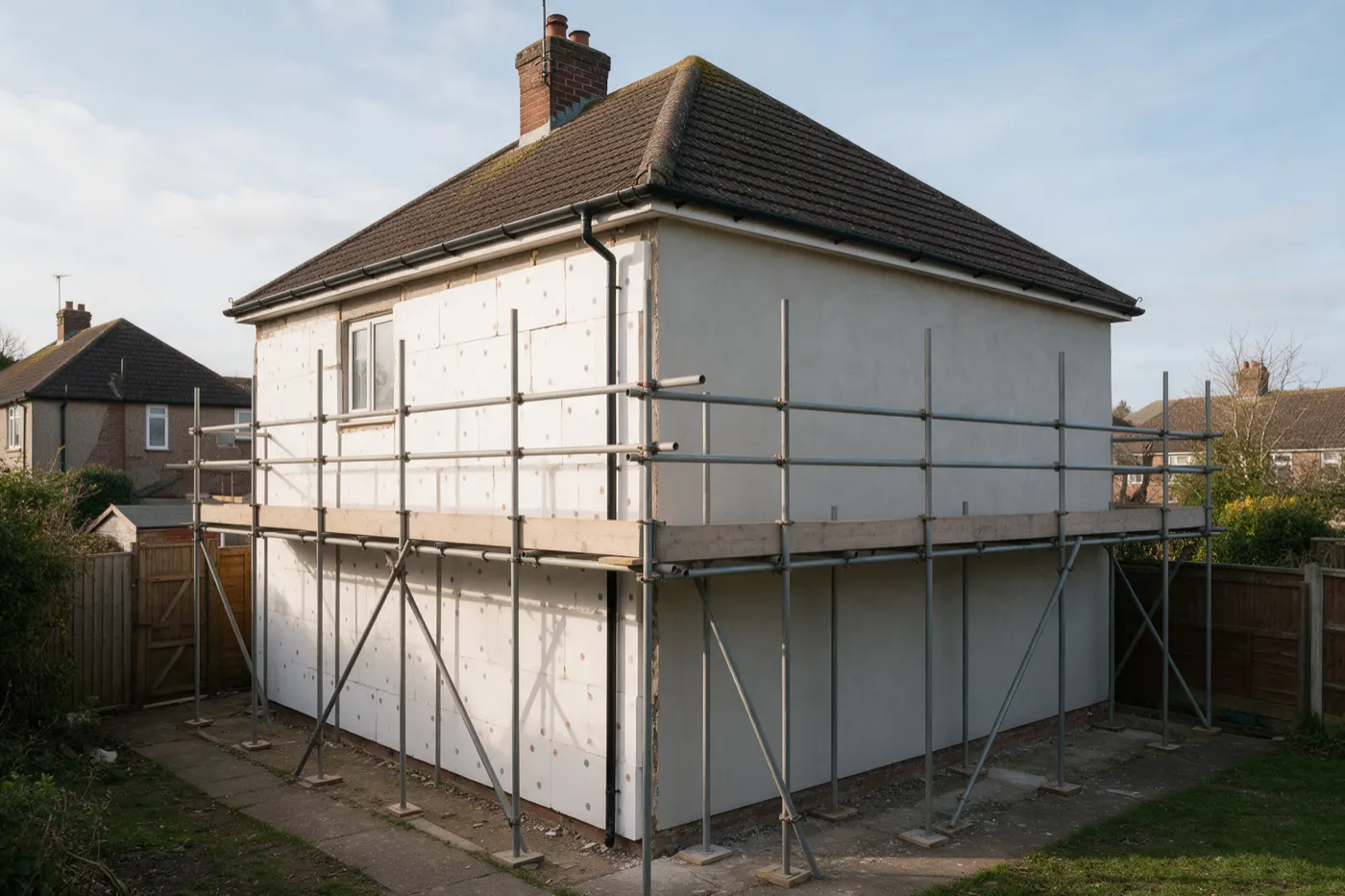
Rigid insulation boards, 50 to 100mm thick to be effective, are fixed to the outside walls, then covered with reinforcing and weatherproof layers and a finish: render, brick-effect slips or another cladding. Any existing surface that can't take the boards is removed first. You don't lose any floor space, and it can refresh how the house looks.
What moves the price, and the hidden costs
The Federation of Master Builders lists the drivers:
- Where you live: London and the South East cost more.
- Size and access: fixed costs such as scaffolding and detailing around openings weigh more on a small house.
- The wall's condition: cracked render, failing masonry, damp or movement need fixing first; removing pebbledash adds cost.
- Labour: about £250 a day per installer.
- Scaffolding: about £625 a week, plus a council licence if it stands on the road or pavement.
- Detailing: window reveals, sills, door frames, pipes, cables and parts of the roofline all have to be altered or extended to suit the thicker wall.
I'd ask each installer to itemise the detailing, because it's where quotes differ and where the work matters most.
Is it right for your house?
The FMB says it isn't always the right answer. Listed buildings, conservation areas, homes exposed to flooding or severe weather, and walls with repair or damp problems need more care, and poor detailing can trap moisture, leading to damp, mould, condensation and cracking. GOV.UK also notes quality problems with some solid wall insulation fitted under ECO, and tells people who are worried what to do.
Internal insulation is the alternative: the Energy Saving Trust puts it at about £12,000 for a semi against £15,000 external, but it goes on the inside of the walls, while the FMB points out that external insulation costs you no floor space.
Building regulations and planning
Building regulations: in England, re-rendering or recladding more than 50% of a wall, or more than 25% of the outside of the house, counts as renovating it, and the wall should then be insulated to 0.3 W/m²K where that's feasible and pays back within 15 years. See the insulation rule.
Planning: on a house in England, cladding the outside can be permitted development, but not in a conservation area, National Park, National Landscape or the Broads, or where the new finish isn't of a similar appearance to the house, and a listed building needs listed building consent. See planning for render and cladding.
Grants and VAT
If you get certain benefits and live in private housing, the Energy Company Obligation (ECO) can help pay for insulation, including solid wall insulation; owners need an energy rating of D to G, private tenants E to G. Apply through your council or an energy supplier. The current scheme, ECO4, runs until 31 December 2026. See ECO in full.
In England, the Warm Homes: Local Grant can pay for wall insulation for lower-income households (usually £36,000 a year or less), on certain benefits or in certain postcodes, in homes rated D, E, F or G. Installed insulation is zero-rated for VAT until 31 March 2027, then 5% from 1 April 2027.
If your walls have a cavity, that's far cheaper to fill: see cavity wall insulation.
Get external wall insulation quotes
External wall insulation is priced per m² of wall, plus scaffolding.
Free, no obligation. We're paid by MyJobQuote when a tradesperson buys your job, never by you.
Frequently asked questions
How much does external wall insulation cost?
On our estimates, about £10,000 to £16,000 for a three-bed semi, or £85 to £200 per m², with no VAT until 31 March 2027.
How much does external wall insulation cost per m²?
About £85 to £200 per m² on our estimates; the Federation of Master Builders' own range sits at the lower end.
Is external wall insulation worth it?
For solid walls in good condition, I'd say yes: it insulates without losing floor space, and the FMB says a modern system should last 30 years or more. It's riskier on damp, exposed or listed buildings, where poor detailing can trap moisture.
Do I need planning permission for external wall insulation?
Often not, but you do in a conservation area, National Park, National Landscape or the Broads, or if the new finish won't look similar to the house, and a listed building needs listed building consent. Check with the council.
How long does external wall insulation take?
About three to four weeks for a typical semi, the Federation of Master Builders says, depending on the weather.
How we priced thisView sources (9, 7 official)
Rules come from the legislation and official guidance, read at source. Prices are our estimates: we check them against trade price data, retailer shelf prices and specialists' price lists, then build them up from their parts so the totals add up. Below are the sources behind the page; the trade price guides we only compare against aren’t listed. Where sources disagreed, we've said so. More on our method.
- IndustryExternal wall insulation cost in the UK (20 March 2026), Federation of Master Builders. Checked 16 Oct 2026.
- IndustrySolid wall insulation, Energy Saving Trust. Checked 16 Oct 2026.
- OfficialHelp from your energy supplier: the Energy Company Obligation, GOV.UK. Checked 16 Oct 2026.
- OfficialExtending the ECO4 end date (consultation outcome, updated 23 January 2026), GOV.UK. Checked 16 Oct 2026.
- OfficialApply for the Warm Homes: Local Grant to improve a home (England), GOV.UK. Checked 15 Oct 2026.
- OfficialEnergy-saving materials and heating equipment (VAT Notice 708/6), HM Revenue & Customs. Checked 16 Oct 2026.
- OfficialApproved Document L: Conservation of fuel and power, Volume 1 Dwellings (2021 edition incorporating 2023 amendments), GOV.UK. Checked 16 Oct 2026.
- OfficialThe Town and Country Planning (General Permitted Development) (England) Order 2015, Schedule 2 Part 1, legislation.gov.uk. Checked 16 Oct 2026.
- OfficialInternal walls: planning permission, Planning Portal. Checked 15 Oct 2026.