
The Short Answer
Start with people you know, your council's approved trader list and TrustMark, the government-endorsed scheme. Then check every builder yourself: ring 2 or 3 recent customers and see the work, check any scheme membership on the scheme's own website, and see their insurance.
Get written, fixed-price quotes from at least 3 builders, sign a written contract, and pay by card in stages. Keep any deposit as small as you can, and Citizens Advice says never more than 25%. We'd walk away from anyone who won't give references, won't put things in writing, or will only take cash.
0 of 5 checks done.
Still to do: ring 2 or 3 recent customers; check any scheme or association membership on its own website; get a written, fixed-price quote; see their insurance policies and check the dates; get a written contract.
Citizens Advice suggests written quotes from at least 3 traders, and no more than a 25% deposit even on a long job. These are checks, not guarantees: a builder can pass them all and still let you down, which is why the contract and paying in stages matter.
Where to look
Recommendations from people whose work you can go and see are a good start. Beyond that, Citizens Advice suggests:
- Your local council. Search its website for "approved traders" or "Trading Standards". The council may list traders it has approved, or link to another website that lists trusted traders in your area.
- Schemes that recommend traders: TrustMark, the Consumer Codes Approval Scheme, Buy with Confidence and Which? Trusted Trader. You may need to try more than one to find someone in your area.
- Trade associations, which often set standards for their members. For builders, the Federation of Master Builders (FMB) says its members pass a vetting and inspection process before they can join.
TrustMark describes itself as the UK's only Government Endorsed Quality Scheme. It licenses scheme providers (accreditation bodies and trade associations, the FMB among them), which check that their TrustMark Registered Businesses keep to its standards. Those businesses give a minimum 2-year guarantee on work in and around the home, must have a complaints process, and if a complaint can't be settled, TrustMark is a member of the Disputes Resolution Ombudsman.
Whoever you find, check the claim yourself: Citizens Advice says to look the builder up on the scheme's or association's own website, and the FMB warns that some businesses claim to be members when they're not.
Checking a builder before you say yes
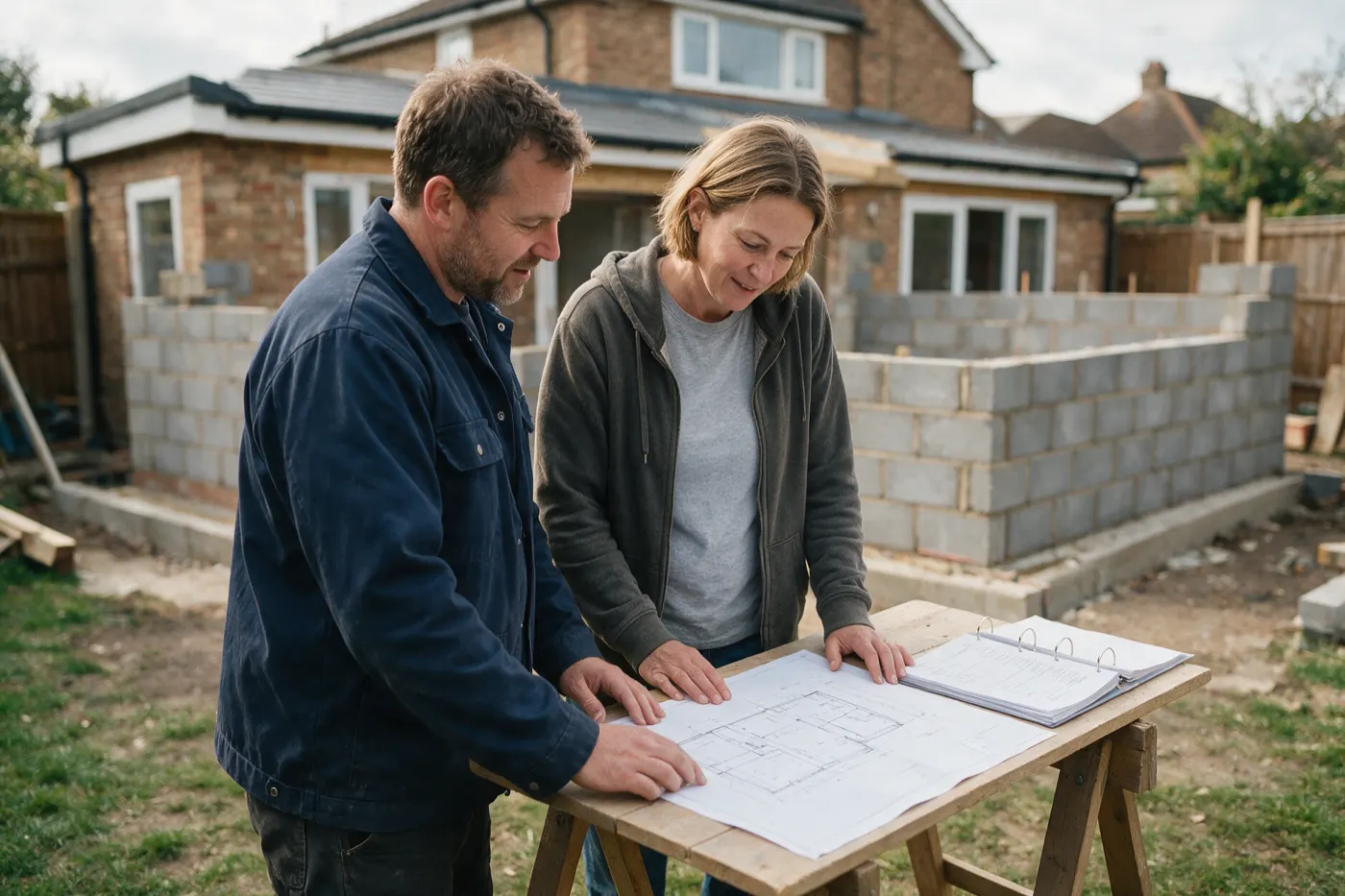
The checks Citizens Advice recommends, which we'd do for every builder on the shortlist:
- References you can follow up. Ask for 2 or 3 recent jobs like yours, with contact details, and get in touch: written references aren't always genuine. Avoid a builder who won't give any.
- Is the business real? Get full contact details, ring the business and check the person works for it. Be wary if all you have is a mobile number: they may be hard to reach if something goes wrong.
- Qualifications. You can ask to see proof, for example an NVQ in construction or a Construction Skills Certification Scheme (CSCS) card.
- Memberships, checked on the scheme's own website, as above. Take extra care if the builder knocked on your door or phoned you out of the blue.
Before you meet anyone, write down exactly what you want done and the questions you'll ask each builder, so you can compare like with like. Write down what they tell you, too. If you're not comfortable with someone, don't use them.
Getting and comparing quotes
Get written quotes from at least 3 builders, and ask first whether they charge for quoting. A quote is a fixed price; an estimate is a rough guess, and you could end up paying more. Citizens Advice says a trader can't charge more than the quote unless you ask for extra work, they tell you extra work is needed and you agree to pay for it, or they made a genuine mistake writing or calculating the price.
A good quote shows:
- a fixed total price, not a daily rate;
- a breakdown of the work and the materials, with separate costs for each;
- how long the price is valid for, and whether it includes VAT;
- when the price can go up (for example, only if you agree to extra work).
If a builder will only work on a day rate, get in writing how many days the job will take, how many hours count as a day, and when they need your go-ahead to work more days. Be cautious about a price far lower than the rest: it can mean they lack the skills, aren't being honest, or haven't quoted for the same work.
To know whether the quotes are in the right area, see our house extension, kitchen extension, loft conversion and house renovation cost guides.
Insurance: theirs and yours
Ask what insurance the builder has, ask to see the policies, and check they don't run out before the job will finish. Citizens Advice lists the cover to look for:
- Public liability: if someone is hurt or property is damaged.
- Employers' liability: if the builder's employees are hurt on the job.
- Professional indemnity: if they do faulty design work or give bad advice (relevant if they're designing as well as building).
- Contractors' all-risk: covers the work if it's damaged or destroyed before it's finished.
Ring your own buildings insurer too, before work starts. It may want to know who the builder is and what cover they have, and your premium may go up during and after the work. If you're a leaseholder, the freeholder or management company usually insures the building, so ask them.
The contract and paying safely
Once you say yes to a quote you have a contract, written or not, but get it in writing: it's what you'll rely on if there's a dispute. It doesn't need legal language. It should cover what you're paying for (it can refer to the quote), start and finish dates and what happens about delays, how rubbish is cleared and who pays for skips, who buys materials and equipment, whether subcontractors will be used, and how and when you pay.
Cancelling. If you agree the contract with the builder at your home (anywhere but their business premises), the Consumer Contracts Regulations usually give you 14 days after the day you enter it to cancel. Ask for the work to start inside those days and you'll usually have to pay for what's been done if you then cancel. There are exceptions, including building a new house and urgent repairs you called the builder out for.
Paying. Citizens Advice's advice, and ours:
- Pay by card, or by bank transfer if you can't. Never cash.
- Pay in stages, tied to points in the work, so problems can be put right before the final payment.
- Avoid a deposit if you can. If the deposit is for materials, offer to buy them yourself. On a long job you may not be able to avoid one: push it down and don't agree to more than 25%. Get a receipt.
- Paying by credit card for work costing £100.01 to £30,000 lets you make a section 75 claim against the card company if things go wrong, and that includes a deposit paid on the card. A debit card gives you chargeback. Cash and bank transfers give you neither.
- If you do pay a deposit, ask whether it's protected by insurance, or held by an escrow company registered with the Financial Conduct Authority.
Get any guarantee in writing, and check how long it lasts, whether it covers materials as well as workmanship, whether it passes to the next owner if you sell, and whether it's insurance-backed (so it still holds if the builder goes out of business).
Your role on an extension or a big job
In England, Part 2A of the Building Regulations gives everyone on a project a role, including you as the "domestic client". Anyone doing building or design work must have the skills, knowledge, experience and behaviours (or, for a company, the organisational capability) to do it so it meets the regulations, and a builder mustn't start until satisfied you're aware of your duties.
- One builder doing everything: most of your client duties are carried out by the builder.
- More than one contractor (for example, if you hire separate firms for different parts of the building work yourself): you should appoint, in writing, a principal designer and a principal contractor. If you don't, the designer in control of the design and the contractor in control of the building work take those roles by default.
In practice, we'd ask at the start: who is managing the design, who is managing the build, who is dealing with building control, and what paperwork you'll get at the end. For neighbours' walls, see our party wall guide: notices can need serving months before a builder can start.
If something goes wrong
Your rights come from the Consumer Rights Act 2015. Every contract for a service includes a term that the builder must do the work with reasonable care and skill, and, where the contract doesn't fix a time, within a reasonable time. What the builder said or wrote about themselves or the work, if you relied on it when deciding, counts as part of the contract too.
If the work falls short, you can require them to do it again properly, at their own cost (labour and materials) and within a reasonable time. If that's impossible, or they don't do it within a reasonable time, you can ask for a price reduction, which can be the full price.
Raise problems with the builder as soon as you notice them and agree the fix in writing. We'd keep photos and copies of everything. If the builder belongs to a scheme or association, use its complaints process: TrustMark and the FMB both have one.
What it costs
Prices, what moves them and who to hire, in our cost guides.
 House extension£2,400 to £3,200 per m²Single-storey extension, standard finish, including VAT
 House renovation£36,900 to £73,8003-bed: rewire, heating, kitchen, bathroom, plaster, decorate
 Kitchen extension£60,500 to £94,40018m² extension, opened up, mid-range kitchen
 Loft conversion£45,000 to £68,000Rear dormer conversion, about 30m²
Free, no obligation. We're paid by MyJobQuote when a tradesperson buys your job, never by you.
Frequently asked questions
How do I find a reliable builder near me?
Ask people whose work you can see, then try your council's approved trader list, TrustMark and the Federation of Master Builders. Check any membership on the scheme's own website, follow up references and see the builder's insurance before you agree anything.
How do I check a builder is legitimate?
Ring 2 or 3 recent customers and see the work, ring the business to check it exists, ask for proof of qualifications such as a CSCS card, check scheme membership on the scheme's own website, and ask to see their insurance policies. Be wary if all you have is a mobile number.
How many quotes should I get from builders?
Citizens Advice says written quotes from at least 3 traders. Make sure each is a fixed price (a quote, not an estimate) for the same work, and says whether VAT is included.
How much deposit should a builder ask for?
Ideally none: Citizens Advice says avoid deposits and pay in stages, and offer to buy materials yourself. On a long job you may not avoid one, but don't agree to more than 25%, pay it by credit card if you can, and get a receipt.
What insurance should a builder have?
Citizens Advice lists public liability, employers' liability if they have employees, contractors' all-risk to cover the work before it's finished, and professional indemnity if they're also doing the design. Ask to see the policies and check the dates.
What are the warning signs of a bad builder?
Citizens Advice's red flags: won't give references, won't put a quote or anything else in writing, only takes cash or wants everything up front, gives only a mobile number, or quotes far below everyone else. Take extra care with anyone who knocks on your door.
How we checked this16 sources · 14 officialView sourcesHide
Rules come from the legislation and official guidance, read at source, and are linked where the guide states them. Practical advice comes from makers', trade bodies' and official guidance; where sources disagreed, we've said so. Prices aren't in our guides: they're on the cost pages linked above, each with its own sources. More on our method.
- OfficialBefore you get work done on your home (England), Citizens Advice. Checked 19 Oct 2026.
- OfficialFind a trader and check you can trust them (England), Citizens Advice. Checked 19 Oct 2026.
- IndustryWhy TrustMark?, TrustMark. Checked 19 Oct 2026.
- IndustryFind a Builder, Federation of Master Builders. Checked 19 Oct 2026.
- OfficialConsumer Rights Act 2015, section 49: service to be performed with reasonable care and skill, legislation.gov.uk. Checked 19 Oct 2026.
- OfficialConsumer Rights Act 2015, section 50: information about the trader or service to be binding, legislation.gov.uk. Checked 19 Oct 2026.
- OfficialConsumer Rights Act 2015, section 52: service to be performed within a reasonable time, legislation.gov.uk. Checked 19 Oct 2026.
- OfficialConsumer Rights Act 2015, section 55: right to repeat performance, legislation.gov.uk. Checked 19 Oct 2026.
- OfficialConsumer Rights Act 2015, section 56: right to price reduction, legislation.gov.uk. Checked 19 Oct 2026.
- OfficialConsumer Contracts (Information, Cancellation and Additional Charges) Regulations 2013, regulation 5: definitions (off-premises contract), legislation.gov.uk. Checked 19 Oct 2026.
- OfficialConsumer Contracts Regulations 2013, regulation 6: limits of application (incl. construction of new buildings), legislation.gov.uk. Checked 19 Oct 2026.
- OfficialConsumer Contracts Regulations 2013, regulation 28: circumstances excluding cancellation (incl. urgent repairs), legislation.gov.uk. Checked 19 Oct 2026.
- OfficialConsumer Contracts Regulations 2013, regulation 30: normal cancellation period, legislation.gov.uk. Checked 19 Oct 2026.
- OfficialConsumer Contracts Regulations 2013, regulation 36: supply of service in the cancellation period, legislation.gov.uk. Checked 19 Oct 2026.
- OfficialThe Building Regulations 2010, Part 2A: dutyholders and competence (England), legislation.gov.uk. Checked 19 Oct 2026.
- OfficialThe Gas Safety (Installation and Use) Regulations 1998, regulation 3, legislation.gov.uk. Checked 15 Oct 2026.
