
The Short Answer
Most kitchen cupboards can be painted, and wood or already-painted doors give the best result. Laminate and melamine doors can be painted too, with a primer made for shiny surfaces. Vinyl-wrapped doors are the exception: Which? doesn't recommend painting them, because paint struggles to grip something that smooth.
The finish is decided before you open the paint: take the doors off, degrease them properly, sand to roughen the surface, prime, then paint in thin coats and let each one dry. Allow a few days to more than a week for a whole kitchen, and longer before the paint is fully hard.
Yes: painted wood is the easiest to repaint.
Roughen the old paint (Ronseal suggests 240 grit), wipe off the dust and prime where needed.
Whatever you use, follow the tin for its primer, coats and drying times, and paint in a room above 10°C.
Is it worth doing?
For a kitchen you're otherwise happy with, it's a lot cheaper than replacing the doors, as Which? and Screwfix both say. The catch is durability: a painted finish is generally less tough than a factory finish, Screwfix notes, so it's more prone to chips and scuffs, especially around the sink.
It's also harder than it looks. When Which? asked 11 of its Trusted Traders (in an article dated 27 April 2026), 64% said it's a job only for people with intermediate or advanced DIY skills, and 73% had been called out to fix cupboards a DIYer had painted, usually because the preparation was rushed. Of 48 Which? members who'd had their cupboards painted, 77% were happy with the result; the most common complaint was paint peeling, chipping or wearing (31%).
Two cases where we'd think twice: unpainted solid wood (painting hides the grain, and Which? warns that a less than perfect job could devalue your home if you're selling soon), and doors that are already peeling or bubbling.
What are your doors made of?
Check before you buy anything, because it decides the primer and whether to paint at all. The smoother the surface, the harder it is for paint to stick.
- Painted wood: the easiest. Roughen the old paint, prime where needed and paint.
- Plain or varnished wood: sand off the old varnish until the surface is slightly rough. Bare wood needs sealing, or tannins in the wood can bleed through as dark spots: Which? says seal the whole door on hardwood and the knots on softwood, or use a primer that seals.
- Laminate or melamine (usually over MDF or chipboard): it can be done, but it's harder to get a lasting finish. Sand until the surface is matt, taking off the sheen rather than the laminate, and use a primer made for glossy surfaces. Expect to touch them up now and then.
- Vinyl or plastic wrap: the smoothest of all. Which? doesn't recommend painting it, and wrap that's already lifting can't be fixed without stripping it off. We'd replace the doors or have them re-wrapped instead: replacement doors and wraps compared.
Which paint and primer
Kitchen doors get handled, splashed and wiped every day, so choose a paint made for furniture or woodwork. Dulux recommends satin, semi-gloss or gloss finishes because they're harder-wearing and easier to clean; eggshell gives a softer sheen that still wipes clean. Water-based paints dry quickly and don't smell much, which matters in a room you're cooking in.
Primer is what makes the paint stick. Match it to the door:
- Laminate, melamine, gloss and hardwood: a shellac-based primer (Which? recommends one for laminate and hardwood). Zinsser says shellac primers grip glossy plastics and other hard surfaces, block stains and seal knots. Water-based "bond" primers are made for hard-to-stick, glossy surfaces too.
- Softwood or already-painted wood: a water-based primer is usually fine, according to Which?.
- Knots and stains: use a stain-blocking primer. Rust-Oleum says its cupboard paint isn't stain-blocking, so knots can bleed through without one.
Some cupboard paints are sold as needing no primer on wood or melamine (Rust-Oleum's and Ronseal's, for example). That saves a coat, not the preparation: Rust-Oleum's own technical data still says to clean with sugar soap, rinse, and roughen hard, glossy or previously painted surfaces first. Whatever you buy, follow the tin for its primer, number of coats and drying times. And cupboard paint isn't for worktops: Rust-Oleum says not to use its paint on them.
Step by step
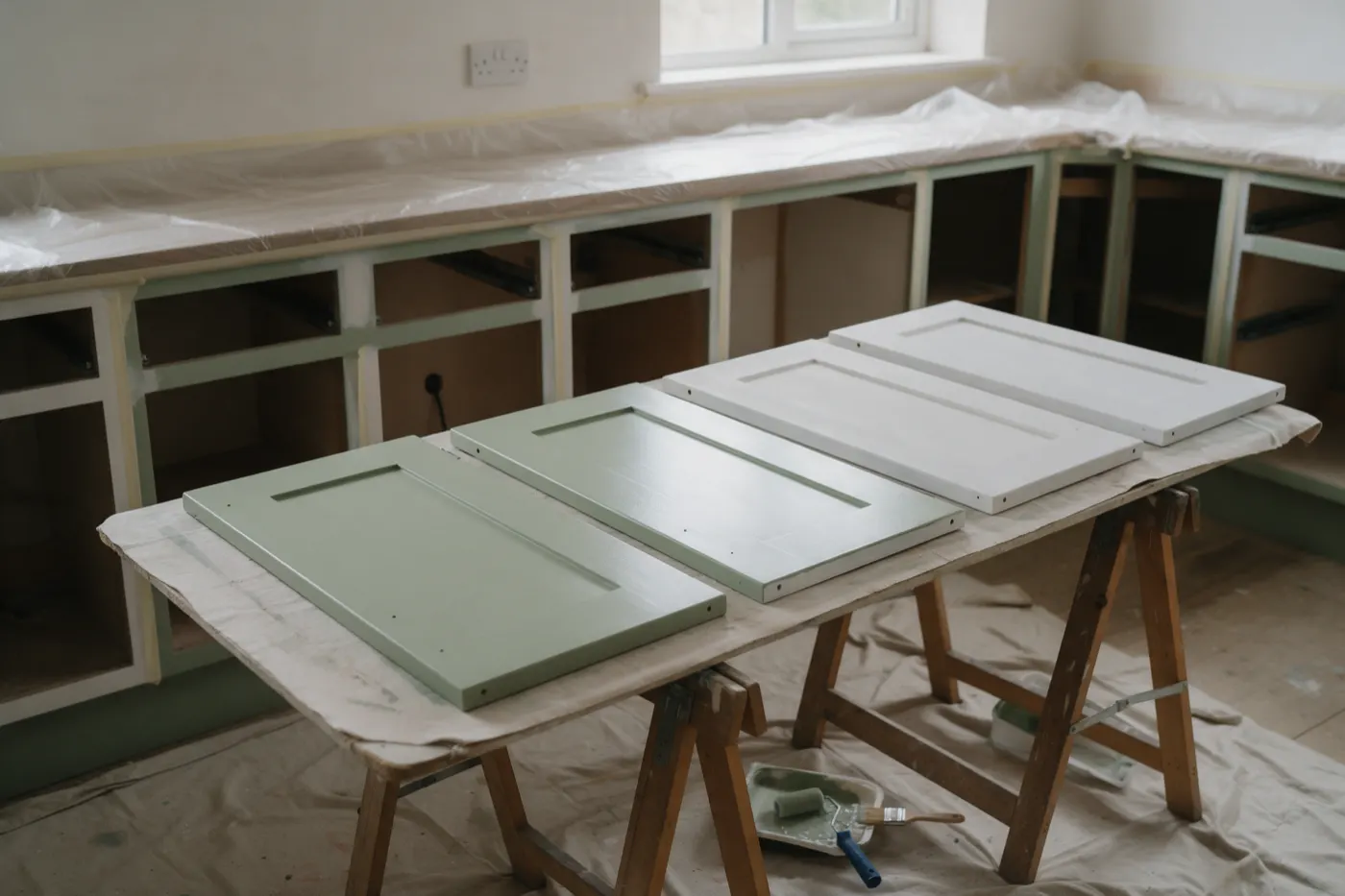
- Take the doors, drawer fronts and handles off. Wickes says leaving them on leads to chips, smudges and uneven wear. Number each door and its cabinet with masking tape, and bag the hinges and screws for each one.
- Protect the room. Empty the cupboards, cover the worktops, floor and appliances, and mask anything you're not painting. Open a window, and make sure the room is warm enough: Ronseal says above 10°C, and Rust-Oleum says it should stay above 10°C while the paint dries too.
- Degrease everything. Screwfix warns that paint on a greasy door can quickly peel. Use sugar soap or a kitchen degreaser (Which? says ordinary soap won't shift years of cooking grease), scrub the corners and grooves, rinse with clean water and let it dry. B&Q advises gloves and eye protection with sugar soap.
- Fill dents and any old handle holes you won't reuse, and sand the filler smooth.
- Sand to roughen, not to strip. Ronseal suggests 240 grit on sound paint, and 120 grit along the grain where old paint is flaking (wear a dust mask). On laminate, sand until it's matt. Vacuum, then wipe with a damp cloth.
- Prime in a thin, even coat, then sand lightly with fine paper once it's dry and wipe off the dust.
- Paint in thin coats. Do the backs first and let them dry, then the fronts. Brush the edges and any recesses first, then roller the flat areas. Lay the doors flat to avoid drips, and paint the cabinet frames while the doors dry. Don't go back over paint that has started to dry.
- Second coat. Most cupboard paints need two (Ronseal sells a one-coat paint, though a bold colour can still need a second). Wait the time on the tin (Rust-Oleum's cupboard paint can be recoated after 4 hours; Wickes says wait 24 hours, and Which? leaves each coat overnight), sand lightly between coats and wipe clean. Going from dark to light usually means an extra coat of primer.
- Refit gently. Wickes says wait at least 24 hours before putting the doors back. Use your numbers, and treat them carefully until the paint has fully cured.
Brush, roller or sprayer?
Which? rates a sprayer as the best option: the smoothest, fastest finish, but it costs more to buy and the paints are dearer. For most people a small roller is the sensible middle ground, with a brush for the edges and details. A brush on its own tends to leave marks on large flat doors.
Use a synthetic brush, and a foam or short-pile roller (Rust-Oleum recommends a short to medium pile mohair one for its paint).
Drying, curing and looking after them
Dry to the touch isn't the same as hard. As examples, Rust-Oleum's cupboard paint takes 7 days to cure fully, and Which? says professional-standard paints take about 3 weeks. Until then, handle the doors as little as possible and keep grease off them.
Once cured, clean them with a damp cloth or soapy water and wipe spills straight away. Avoid abrasive cleaners: Ronseal says they can damage the paint.
The mistakes that make paint peel
- Skipping or rushing the degreasing.
- Painting straight onto shiny laminate, melamine or gloss without roughening it or using the right primer.
- Painting vinyl-wrapped doors.
- Thick coats, or a new coat over paint that's still soft.
- Painting in a cold room (below 10°C).
- Refitting and using the doors before the paint has cured.
- Sanding back old paint that might contain lead.
Having it done instead
If you want a finish closer to new, some kitchen respray firms collect the doors, spray them at their own premises and bring them back. Spraying gives the smoothest finish, and it's worth paying for if you're not confident with the preparation.
Our replacement kitchen doors guide compares a respray, a vinyl wrap and new doors, with what each costs. If you're painting the walls at the same time, see interior painting costs; and if the units themselves are worn out, a new kitchen may be the better spend.
What it costs
Prices, what moves them and who to hire, in our cost guides.
Free, no obligation.
Frequently asked questions
Can I just paint over my kitchen cupboards?
Not straight onto them. They need degreasing and a light sand first so the paint can grip, and laminate, melamine or gloss doors need a primer made for shiny surfaces. Some cupboard paints are sold as needing no primer, but the makers still ask for a clean, roughened surface.
Is painting kitchen cupboards a good idea?
It's a good way to change the colour of a kitchen you're happy with, but a painted finish is generally less hard-wearing than a factory one. When Which? asked 48 members, 77% were happy with the result; peeling and chipping were the most common complaints.
What kind of paint do you use on kitchen cupboards?
A durable paint made for furniture or woodwork, in a satin, eggshell or gloss finish that wipes clean, over the primer that suits your doors. Water-based paints dry quickly and smell less.
What are the most common mistakes when painting kitchen cupboards?
Not degreasing properly, skipping the sanding or primer, painting vinyl-wrapped doors, thick coats, painting in a room below 10°C and refitting the doors before the paint has cured.
Is it better to paint kitchen cupboards with a brush or a roller?
A small foam or short-pile roller for the flat areas and a synthetic brush for the edges and details. A brush alone can leave marks on flat doors; a sprayer gives the smoothest finish but costs more.
Do I have to take the doors off to paint kitchen cupboards?
It's much better if you do. Wickes says leaving them on leads to chips, smudges and uneven wear, and painting them flat avoids drips. Number each door so it goes back in the right place.
How long does it take to paint kitchen cupboards?
Which? puts it at a few days to more than a week for a whole kitchen, because each coat needs to dry. Full curing takes longer: 7 days for Rust-Oleum's cupboard paint, about 3 weeks for professional-standard paints, according to Which?.
How we checked this13 sources · 1 officialView sourcesHide
Rules come from the legislation and official guidance, read at source, and are linked where the guide states them. Practical advice comes from makers', trade bodies' and official guidance; where sources disagreed, we've said so. Prices aren't in our guides: they're on the cost pages linked above, each with its own sources. More on our method.
- IndustryHow to paint kitchen cabinets: an expert, step-by-step guide (27 April 2026; Which? Trusted Traders and members surveys), Which?. Checked 20 Oct 2026.
- OfficialLead: information for the public (published 8 October 2024), UK Health Security Agency (GOV.UK). Checked 20 Oct 2026.
- IndustryHow to paint kitchen cabinets, Dulux. Checked 20 Oct 2026.
- IndustryDr Dulux: How to paint kitchen cupboards, Dulux. Checked 20 Oct 2026.
- IndustryHow to paint your kitchen cupboards, Rust-Oleum. Checked 20 Oct 2026.
- IndustryKitchen Cupboard Paint: product page and technical data, Rust-Oleum. Checked 20 Oct 2026.
- IndustryOne Coat Cupboard Paint (water-based): technical specification and usage guide, Ronseal. Checked 20 Oct 2026.
- IndustryB-I-N shellac primer-sealer, Zinsser UK. Checked 20 Oct 2026.
- IndustryBulls Eye 1-2-3 primer-sealer, Zinsser UK. Checked 20 Oct 2026.
- IndustryPainting kitchen cabinets and doors, Screwfix. Checked 20 Oct 2026.
- IndustryHow to paint kitchen cabinets, Wickes. Checked 20 Oct 2026.
- IndustryHow to paint kitchen cabinets (6 October 2026), B&Q. Checked 20 Oct 2026.
- IndustryKitchen respray price list, The Kitchen Respray Factory. Checked 15 Oct 2026.