The Short Answer
Without a driveway, the way to charge at home is a cross-pavement solution: usually a narrow channel set into the pavement that your charging cable sits in while the car charges. Your council decides whether you can have one, so ask it first.
In England, from 21 October 2026, you no longer need planning permission for the channel or for one wall charger on the front of your house, unless you're in a conservation area or at a listed building. There's a grant of 75% off the charger, up to £500, if you fit one with a channel. What you mustn't do is trail a cable across the pavement.
Your options
You're far from alone. About 8 million households in England (32%) have no off-street parking, and about 4 million of them (16% of all households) can usually park outside their home (Department for Transport). The realistic options are:
- A cross-pavement solution with a charger on your house: home electricity, home tariffs, but only if your council allows it.
- Public chargers on your street, often in lamp posts or bollards, if your council has them.
- Making a driveway, which needs a dropped kerb and the council's approval. See dropped kerb costs.
What a cross-pavement solution is
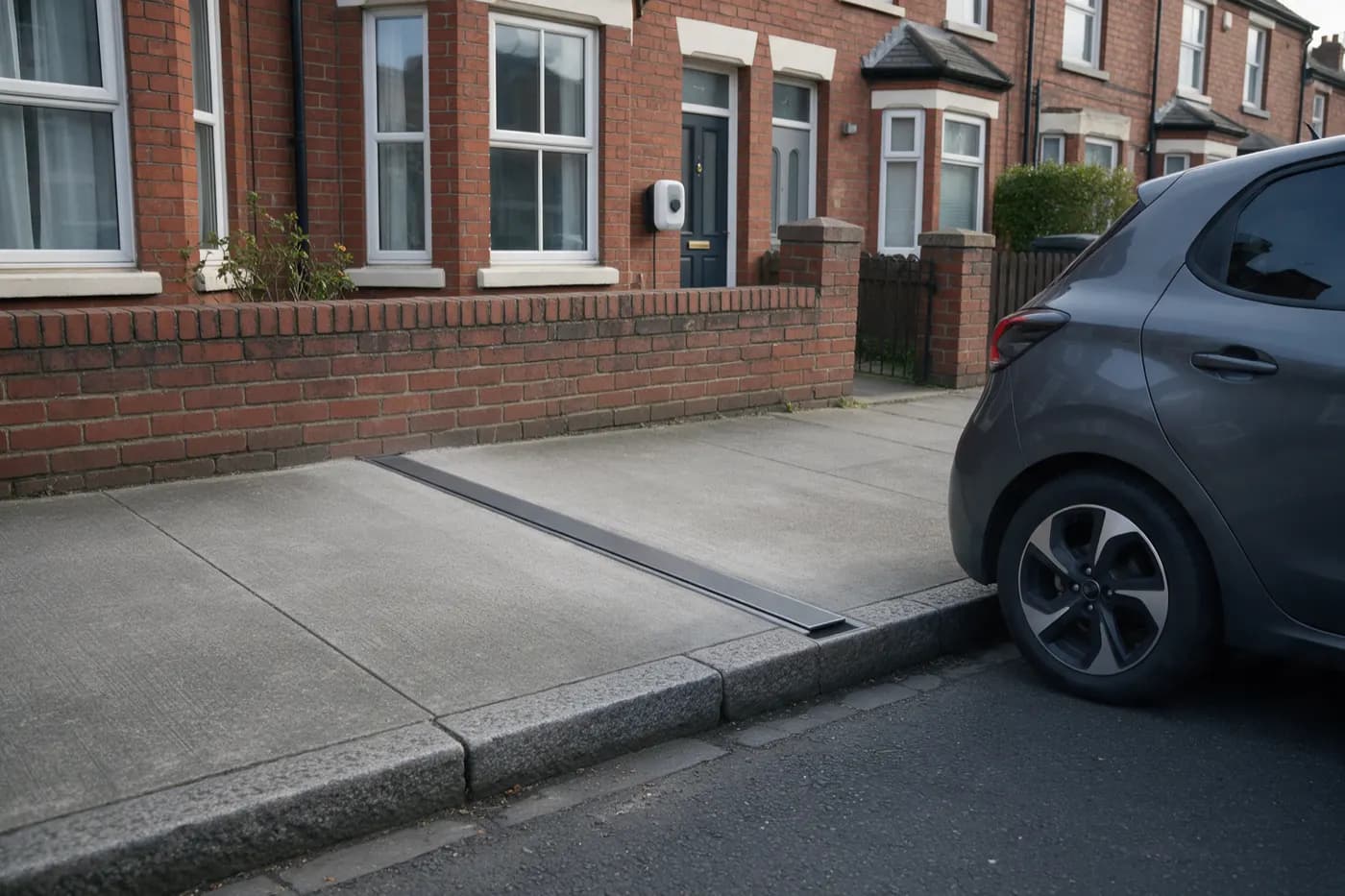
The Department for Transport's guidance for councils describes two main types:
- A cable channel set into the pavement, often called a gully. You lay your charging cable in it while the car charges and take it out afterwards. This is the most common type.
- A permanent cable under the pavement, running from your charger to a removable bollard or connector at the kerb.
Cable covers or mats laid on top of the pavement don't count as a cross-pavement solution, and they don't qualify for the grant.
A channel doesn't give you the parking space outside your house: anyone can still park there. The guidance says it works best where you can park outside at least once a week.
The new planning rules (England)
A change to the planning rules came into force on 21 October 2026 (SI 2026/1056). Before it, a home charger only had permitted development rights where there was off-street parking. Now:
- The channel: a cross-pavement solution put in by, for, or with the permission of the highway authority (your council, in most places) no longer needs planning permission. It has to be taken out, and the pavement put back, once it's no longer needed.
- The charger on your house: one wall charger is permitted development even without off-street parking, as long as it's no more than 1.6m off the ground. If your wall is right next to the pavement, it can't stick out more than 0.2m, and at least 1.5m of pavement must be left.
- The cable: where there's a pavement between the charger and the car, the cable has to cross it through a cross-pavement solution the highway authority has approved. A standard three-pin socket doesn't count as a charger under these rules.
- Where it doesn't apply: conservation areas, the grounds of a listed building and scheduled monuments. There you'll still need planning permission.
These rules are for England. Scotland, Wales and Northern Ireland handle roads and planning differently, so check with your council there.
How to get one
Planning permission was only part of it. The council, as highway authority, still decides whether a channel can go in its pavement at all, and it looks at things like the width of the pavement, yellow lines, crossings and what's buried underneath. Some councils don't allow channels yet: The Guardian reported on 21 October 2026 that more than 20 were still holding out.
So we'd go in this order:
- Ask your council whether it allows cross-pavement channels and how to apply. Some run their own scheme; others approve set suppliers or let you choose one.
- Check you're not in a conservation area, and whether your home is listed.
- Read the terms. Depending on the council, the channel may be owned by the council or the supplier, paid for once or by subscription, and come with conditions such as public liability insurance and an electrical safety certificate for your charger.
- Then get the charger fitted by a qualified electrician. You're responsible for the charger and the cable; the council or supplier for the channel, depending on the scheme. See EV charger installation costs.
If you sell your home, the buyer needs to know about the channel and its agreement, so we'd tell your solicitor.
The grant
The Chargepoint Grant for Households with On-Street Parking gives 75% off buying and installing the charger, up to £500. You can apply if you:
- own or rent the home you live in;
- don't have private off-street parking, and can usually park on the street;
- are fitting a proper cross-pavement solution (not covers or mats) with the highway authority's permission;
- own or are responsible for an eligible vehicle;
- haven't had the charger fitted yet: the grant can't be backdated.
It's funded until 31 March 2027, and the government can change or end it, so check it's still open before you book.
Don't trail a cable across the pavement
Public on-street chargers
Many councils work with charging companies to put public chargers on residential streets, often built into lamp posts or as small bollards. According to Zapmap, most are 3kW, 5kW or 7kW and take about 6 to 12 hours to get a car to 80% or more, so they suit overnight charging. Most don't have a cable attached, so you'll need your own.
Charging maps such as Zapmap's can filter for on-street chargers near you.
What it costs
Prices, what moves them and who to hire, in our cost guides.
Free, no obligation.
Frequently asked questions
Can I charge my car across the pavement?
Only through a cross-pavement solution your council has approved, such as a cable channel set into the pavement. Trailing a loose cable across it is a trip hazard and may breach the Highways Act 1980.
Do I need planning permission for a cross-pavement gully?
Not in England from 21 October 2026, if it's put in by or with the permission of the highway authority, unless you're in a conservation area, at a listed building or on a scheduled monument. You still need the council's permission to put it in the pavement.
Can I get a home EV charger without a driveway?
Yes, if your council allows a cross-pavement solution outside your home. Ask the council first, then have the charger fitted by a qualified electrician.
Is there a grant for EV charging without a driveway?
Yes: the chargepoint grant for households with on-street parking gives 75% off the charger, up to £500, if you fit it with an approved cross-pavement solution. Apply before the charger is fitted; it's funded until 31 March 2027.
Does a cable channel reserve the parking space outside my house?
No. Anyone can still park there, so it works best where you can usually park outside your home.
How we checked this6 sources · 4 officialView sourcesHide
Rules come from the legislation and official guidance, read at source, and are linked where the guide states them. Practical advice comes from makers', trade bodies' and official guidance; where sources disagreed, we've said so. Prices aren't in our guides: they're on the cost pages linked above, each with its own sources. More on our method.
- OfficialCross-pavement solutions for charging electric vehicles (December 2024), Department for Transport / OZEV. Checked 21 Oct 2026.
- OfficialThe Town and Country Planning (General Permitted Development) (England) (Amendment) (No. 2) Order 2026, legislation.gov.uk. Checked 21 Oct 2026.
- OfficialElectric Vehicle Chargepoint Grant for Households with On-Street Parking, GOV.UK Find a grant. Checked 21 Oct 2026.
- OfficialChanges to electric vehicle chargepoint grant schemes from 1 April 2026, GOV.UK. Checked 21 Oct 2026.
- IndustryWhat is on-street charging?, Zapmap. Checked 21 Oct 2026.
- IndustryCould new rules cut costs for EV drivers? (21 October 2026), The Guardian. Checked 21 Oct 2026.