The Short Answer
On a house, garage or extension you'll usually be choosing between three coverings: felt (modern bitumen membranes, torched on or self-adhesive), EPDM (a synthetic rubber sheet, glued down cold) or GRP (fibreglass, laid as wet resin and glass mat). Liquid roofing is painted or rolled on, and is often laid over an old roof. There are also single ply plastic sheets and mastic asphalt.
No one type is best for every roof. For a typical garage or extension we'd look at EPDM or GRP, or a flame-free felt system; for a roof you'll walk on, GRP, liquid or asphalt. Whichever you pick, the installer matters as much as the material: the makers' long lives and guarantees only apply to their systems fitted to their instructions.
The main types at a glance
| Felt (bitumen) | EPDM rubber | GRP fibreglass | Liquid roofing | |
|---|---|---|---|---|
| What it is | Layers of reinforced bitumen membrane with a mineral-finished top sheet | One sheet of synthetic rubber | Polyester resin and glass fibre mat, then a topcoat | A coating brushed, rolled or sprayed on, ideally with a reinforcing fleece or mat |
| How it's laid | Torched on with a flame, or self-adhesive (flame-free) | Glued down cold with contact adhesive | Laid cold as a liquid | Applied wet, often over the old covering |
| What the maker says | IKO: at least 35 years for its bitumen membranes | Elevate: over 50 years | Scott Bader: 10 to 15-year warranty, 20 or 25 years on its premium system | Varies by product: check its BBA or similar certificate |
| Good for | Most roofs; it can be overlaid with a new layer later | Most house roofs in one piece, without joins | Detailed roofs, balconies and walkways | Refurbishing a roof that's failing at its joins, and awkward details |
Felt: torch-on and self-adhesive
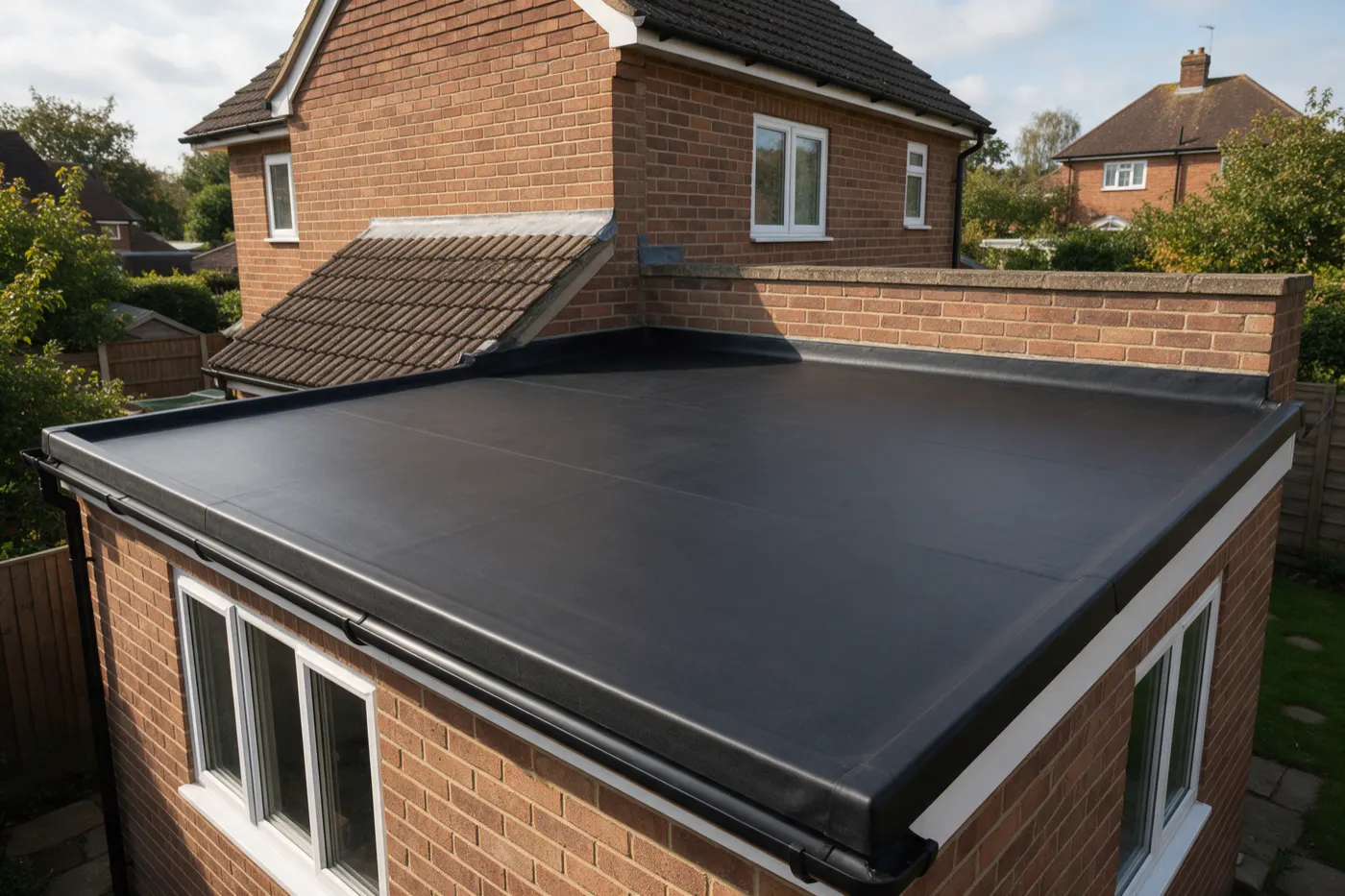
Today's "felt" is reinforced bitumen membrane, usually laid in layers: underlays, then a cap sheet with a mineral finish that protects it from UV. IKO, which makes them, says most torch-on membranes in the UK are SBS (rubber-modified) bitumen, which stays flexible in the cold. IKO says its bitumen membranes last at least 35 years, and that a bitumen roof can be overlaid with a new layer without stripping the old one (IKO).
Torch-on means melting the membrane on with a gas flame, and that's a fire risk. IKO says torch-on shouldn't be used on timber structures because of that risk, and the roofing trade body's Safe2Torch guidance says that wherever a fire risk can't be ruled out, the roof should be specified with torch-free methods instead.
The flame-free alternative is self-adhesive felt. IKO's self-adhesive system has a BBA certificate giving it a life of more than 20 years. If your roof has a timber deck and a roofer quotes torch-on, we'd ask why, and whether they follow Safe2Torch.
EPDM rubber
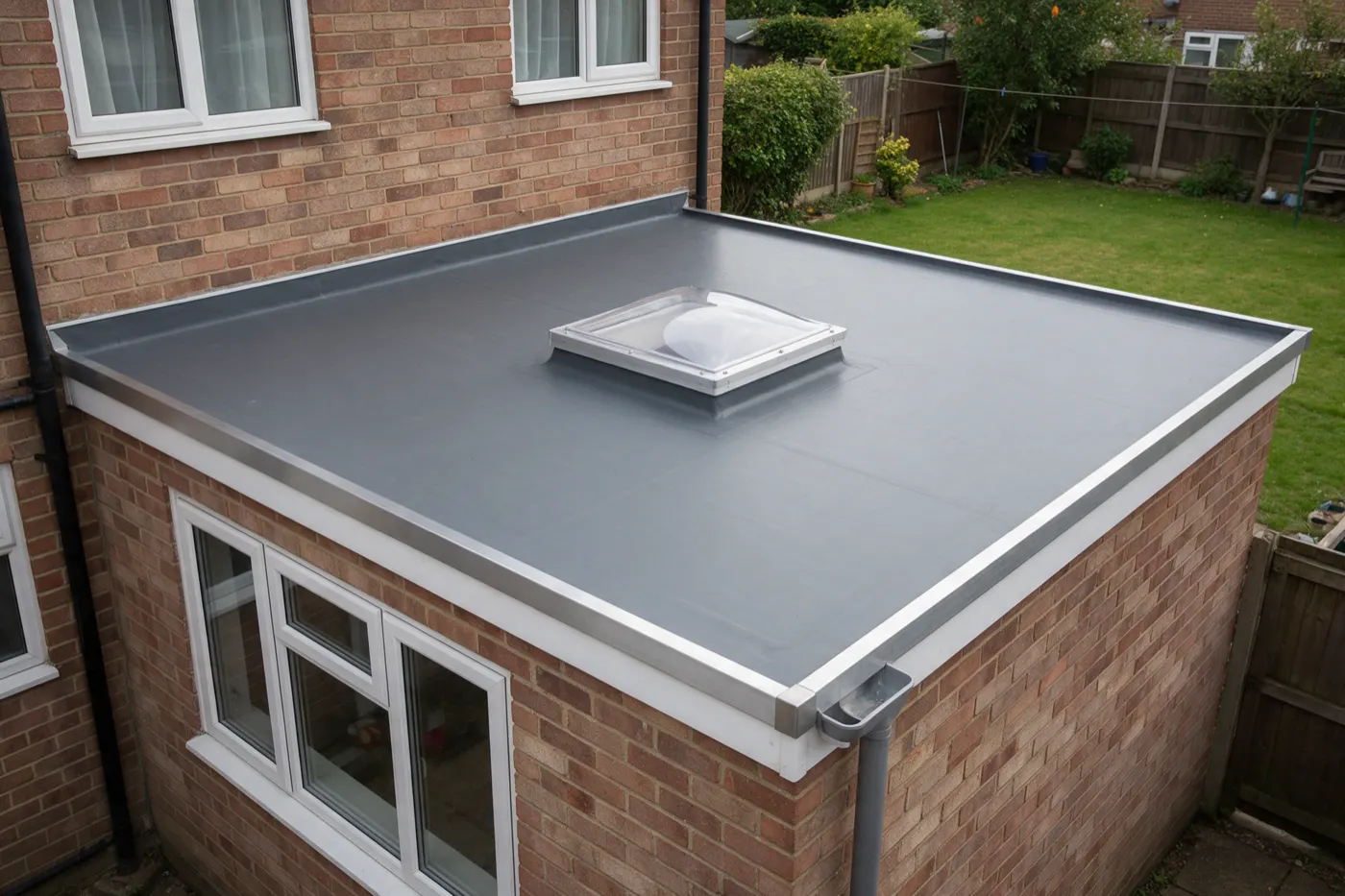
EPDM is a synthetic rubber membrane, often just called a rubber roof. Holcim Elevate, which makes the RubberCover EPDM system for house roofs, says it comes in sheets big enough to cover most house roofs in one piece, with no joins across the roof, and it's stuck down cold with contact adhesive, so there's no flame.
Elevate claims a life of over 50 years, and says the membrane can stretch more than 300% to cope with movement. It recommends a thicker membrane if you want a green roof or solar panels on top, so if either is on the cards, tell your roofer before they order.
GRP fibreglass
GRP (glass reinforced plastic) is laid as wet resin with a glass fibre mat, then finished with a coloured topcoat. Scott Bader, which makes CrysticROOF, describes it as a cold-laid liquid system for roofs, walkways and balconies, with smooth, anti-slip and aggregate finishes.
Because it's laid wet, it forms one continuous skin, and Scott Bader shows it on complex roof shapes as well as plain flat ones. Scott Bader gives a 10 to 15-year warranty on its standard system, and a 20 or 25-year material guarantee on its BBA-approved premium system, which only its approved installers can offer. So for a GRP roof, we'd check the installer is approved by the maker whose system they're quoting.
Liquid roofing (including "liquid rubber")
Liquid roofing covers a whole family of coatings: the Liquid Roofing and Waterproofing Association lists polyurethanes, PMMA, bitumen-based coatings and polyester resins (the same family as GRP), among others. They're applied wet and bond fully to the surface, so they're seamless. The association says that makes them well suited to going over an old roof that's failing at its joins or nearing the end of its life.
More detail: LRWA on reinforcement.
Single ply and mastic asphalt
- Single ply plastics (PVC and FPO or TPO): light sheets, typically 2 to 3kg per m² (Bauder), with the joins welded together with heat. They can be glued, fixed down mechanically or laid loose. Protan describes TPO (thermoplastic olefin) as a single-layer membrane for flat and low-pitched roofs, on commercial and residential buildings.
- Mastic asphalt: laid hot as a molten material, though the Mastic Asphalt Council points out there's no naked flame where it's laid. It's heavy-duty: the council says it's used where there's sustained foot traffic, on car parks and structural decks and under green roofs, and that it can be repaired easily.
Which type suits your roof?
- A garage or small extension on a timber deck: EPDM, GRP or a flame-free felt system. Avoid torch-on on timber.
- An awkward roof with lots of upstands, rooflights or corners: GRP or a reinforced liquid system, which are laid wet and form one skin round the details.
- A roof you'll walk on, such as a balcony: a system made for foot traffic, such as GRP with an anti-slip finish, a liquid balcony system or mastic asphalt. Say so before you get quotes.
- An old roof that's leaking at its joins but is otherwise sound: a reinforced liquid overlay, or a new felt layer over the old one, may save stripping it.
- Solar panels or a green roof later: tell the roofer now; some systems need a heavier membrane.
If there's a heated room below, replacing the covering usually brings in the building regulations' insulation rule. That, and the prices for each type, are on flat roof costs. Re-felting a garage or shed: roof re-felting costs.
How long does a flat roof last?
It depends on the type, the system and the fitting. The makers' own figures:
- Bitumen felt: at least 35 years for IKO's membranes; more than 20 years on the BBA certificate for its self-adhesive system.
- EPDM: over 50 years (Elevate).
- GRP: a 10 to 15-year warranty on Scott Bader's standard system, and 20 or 25 years on its premium one.
A guarantee is not the same as a life: it's what the maker will stand behind, often only through its approved installers. The covering is also only as good as the deck under it and the details at the edges: Which? lists cracks or splits round the edges among the warning signs of a failing flat roof. Ask for the maker's guarantee in writing, naming the system.
What it costs
Prices, what moves them and who to hire, in our cost guides.
Free, no obligation.
Frequently asked questions
What type of flat roof is best?
There's no single best. EPDM, GRP and flame-free felt all suit a typical garage or extension; GRP and reinforced liquid systems handle awkward details; GRP, liquid and mastic asphalt suit roofs you walk on. The installer and the maker's guarantee matter as much as the material.
Is EPDM or GRP better?
Neither wins outright. EPDM goes down cold in one sheet, with no joins across the roof, and its maker claims over 50 years. GRP is laid wet, so it forms one skin around awkward details and can take foot traffic with an anti-slip finish, but its guarantee depends on using the maker's approved installer.
Which flat roof lasts the longest?
On the makers' own claims, EPDM (over 50 years from Elevate) and bitumen membranes (at least 35 years from IKO). Those are best cases for their own systems, fitted properly; a guarantee is usually shorter.
Can you walk on a flat roof?
Only if it's built for it. Ask for a system designed for foot traffic, such as GRP with an anti-slip finish, a liquid balcony system or mastic asphalt, and check the roof structure can take it before using it as a balcony.
Is liquid rubber good for flat roofs?
A proper reinforced liquid roofing system with a BBA or similar certificate can be, especially over an old roof failing at its joins. The Liquid Roofing and Waterproofing Association warns against unreinforced products sold through merchants, so we wouldn't rely on a DIY tin over a room.
Can a flat roof be torched on over timber?
IKO says torch-on membranes shouldn't be used on timber structures because of the fire risk, and NFRC's Safe2Torch guidance says to use torch-free methods wherever a fire risk can't be ruled out. Flame-free options include self-adhesive felt, EPDM and GRP.
How we checked this13 sourcesView sourcesHide
Rules come from the legislation and official guidance, read at source, and are linked where the guide states them. Practical advice comes from makers', trade bodies' and official guidance; where sources disagreed, we've said so. Prices aren't in our guides: they're on the cost pages linked above, each with its own sources. More on our method.
- IndustryWhat is torch-on roofing and why is it used?, IKO. Checked 27 Oct 2026.
- IndustryWhat is the lifespan of an IKO bituminous roofing membrane?, IKO. Checked 15 Oct 2026.
- IndustryIKO ULTRA Stick flame-free roofing and waterproofing systems, IKO. Checked 23 Oct 2026.
- IndustrySafe2Torch, National Federation of Roofing Contractors. Checked 23 Oct 2026.
- IndustryRubberCover EPDM membrane (residential roofing), Holcim Elevate (Firestone). Checked 15 Oct 2026.
- IndustryCrysticROOF GRP roofing brochure (UK), Scott Bader. Checked 15 Oct 2026.
- IndustryGeneric types of liquid applied membranes, Liquid Roofing and Waterproofing Association. Checked 23 Oct 2026.
- IndustryThe importance of reinforcement, Liquid Roofing and Waterproofing Association. Checked 23 Oct 2026.
- IndustryRoofing overlay systems, Liquid Roofing and Waterproofing Association. Checked 23 Oct 2026.
- IndustrySingle ply membrane roofing systems, Bauder. Checked 23 Oct 2026.
- IndustryTPO roofing membranes, Protan. Checked 23 Oct 2026.
- IndustryWhy specify mastic asphalt?, Mastic Asphalt Council. Checked 23 Oct 2026.
- IndustryHow much do roof repairs cost? (Which? Trusted Traders survey, November 2025), Which?. Checked 26 Oct 2026.