The Short Answer
Painting a fence is a job most people can do themselves, and repainting an existing fence takes only a few hours. What decides how long it lasts is the weather and the preparation, not the brush.
- Pick your days: dry and mild, above 5°C, with no rain forecast. Spring and early autumn are best.
- Prepare it: brush it down, wash it, let it dry completely, scrape off flaking paint and fix anything loose.
- Paint along the boards with a brush, roller or sprayer, then give it a second coat once the first is dry.
If the fence belongs to your neighbour, ask before you paint your side.
Repaint or replace?
- Faded, grey or patchy but solid: repaint. This is what fence paint is for, and it protects the wood from rot.
- A few split boards or a loose rail: repair those, then paint.
- Rotten posts, or panels soft and crumbling: paint won't save it. See what a new fence costs, and paint the new one once it's had time to weather (see below).
When to paint it
Pick a dry, mild spell in spring or early autumn, when it's not too hot. You need more than one good day: allow a few days without rain. The paint sets limits too, so check the tin: Cuprinol's Garden Shades, for one, is to be applied only in dry conditions, above 5°C, with no bad weather forecast.
- After rain: don't paint a wet fence, as it spoils the finish. Wait a day or two for the wood to dry.
- Heatwaves: avoid very hot or very humid days too. Paint dries too fast and the finish suffers.
- Winter: paint takes longer to dry in the cold, and if the fence freezes overnight the paint can peel or crack. We'd leave it until spring.
A typical plan
- A dry day beforehand: clear the fence, brush it down, wash it and treat any green growth. Leave it to dry completely.
- Day one: scrape and sand, make repairs, treat any bare wood with preserver, and cover the patio and plants.
- Day two: the first coat, once the preserver has had at least 16 hours to dry.
- The second coat once the first is dry: later the same day if it dries quickly, otherwise the next day.
If there's no bare wood to treat, you can start painting on day one and finish in a weekend.
Getting the fence ready
Most of the work is preparation, and it's worth doing all of it:
- Clear the space. Take down hanging baskets and trellis, move pots and furniture, and cut back anything growing against the fence. Pull out old nails or screws sticking out of it.
- Brush it down with a stiff brush to get rid of dirt and cobwebs.
- Wash it with a pressure washer, or warm soapy water and a sponge, then rinse with clean water. Let it dry completely before you paint.
- Get rid of green growth. Don't paint over algae: it keeps growing underneath and makes the paint peel. Use a mould remover or diluted bleach, leave it to work, then rinse it off thoroughly.
- Scrape off flaking paint and sand any stubborn patches smooth, along with any rough, splintery areas.
- Make repairs. Fill small cracks and holes with wood filler, and deal with loose boards, rot and badly damaged panels before you paint.
- Treat bare wood with a preserver to stop it decaying. Use a clear preserver made to go under paint: allow 2 to 6 hours between coats and at least 16 hours to dry before you paint.
- Cover what you don't want painted: sheets or tarpaulin over the patio, decking and furniture, and masking tape on anything fixed to the fence, such as a metal gate.
Painting a new fence
Pressure-treated fencing has already had a preservative treatment against rot, so a newly installed fence probably won't need painting straight away, partly because of the chemical residue. Paint it for the look once it has had a short time to weather, and when it's clean and completely dry. Check the paint is suitable for pressure-treated wood before you buy.
Which paint or treatment
Most fence paints are sold as shed and fence paints or treatments, and they come in two main types:
- Water-based: easier to apply evenly, quicker to dry and lower in fumes. The downsides: it can dry too fast in hot weather, may need repainting sooner, and doesn't seal weathered or untreated wood as well.
- Oil-based: soaks deeper into the wood and lasts longer, which makes it the better choice for an old, weathered fence. It takes much longer to dry and needs a solvent to clean brushes.
What we'd choose: water-based for a fence in reasonable condition, because it's easier to get an even finish and it dries faster between coats. Oil-based for an old, dry, weathered fence that soaks paint up.
A few more things to check on the tin:
- The surface. Paints are made for different woods: some for rough-sawn panels, some for smooth, treated wood. The packaging says which.
- Spraying. Not every paint can go through a sprayer, and many need watering down first. The tin says whether it can be sprayed and how much to thin it.
- Going lighter. To cover a dark fence with a light colour, sand it, prime it with a couple of coats of a white or cream wood treatment, then paint.
- Not for decking. Fence paint isn't made for foot traffic, so don't use it on decking.
Don't go looking for creosote. The House of Commons Library says consumer use of creosote was banned in the UK in 2003; it's now only allowed for specified industrial uses, such as telegraph poles.
Brush, roller or sprayer?
- Brush: slower, but the most control. Use a wide exterior brush for the boards and a small one for edges, corners and round plants. Use a brush rather than a sprayer if there are big gaps between the boards, or you'll paint your neighbour's garden too.
- Roller: faster on big, flat panels. Use a medium-to-long pile (10 to 19mm) for rough wood, with a brush for the bits it can't reach.
- Sponge: messy but quick, and it works paint into the rough grain. Wear gloves.
- Sprayer: the quickest, especially on a long fence, but only with a sprayable paint, and there's overspray. Cover anything nearby, and wear goggles, gloves and a mask.
For a typical garden fence we'd use a brush and roller. A sprayer earns its keep on a long run of fence with nothing growing against it.
Step by step
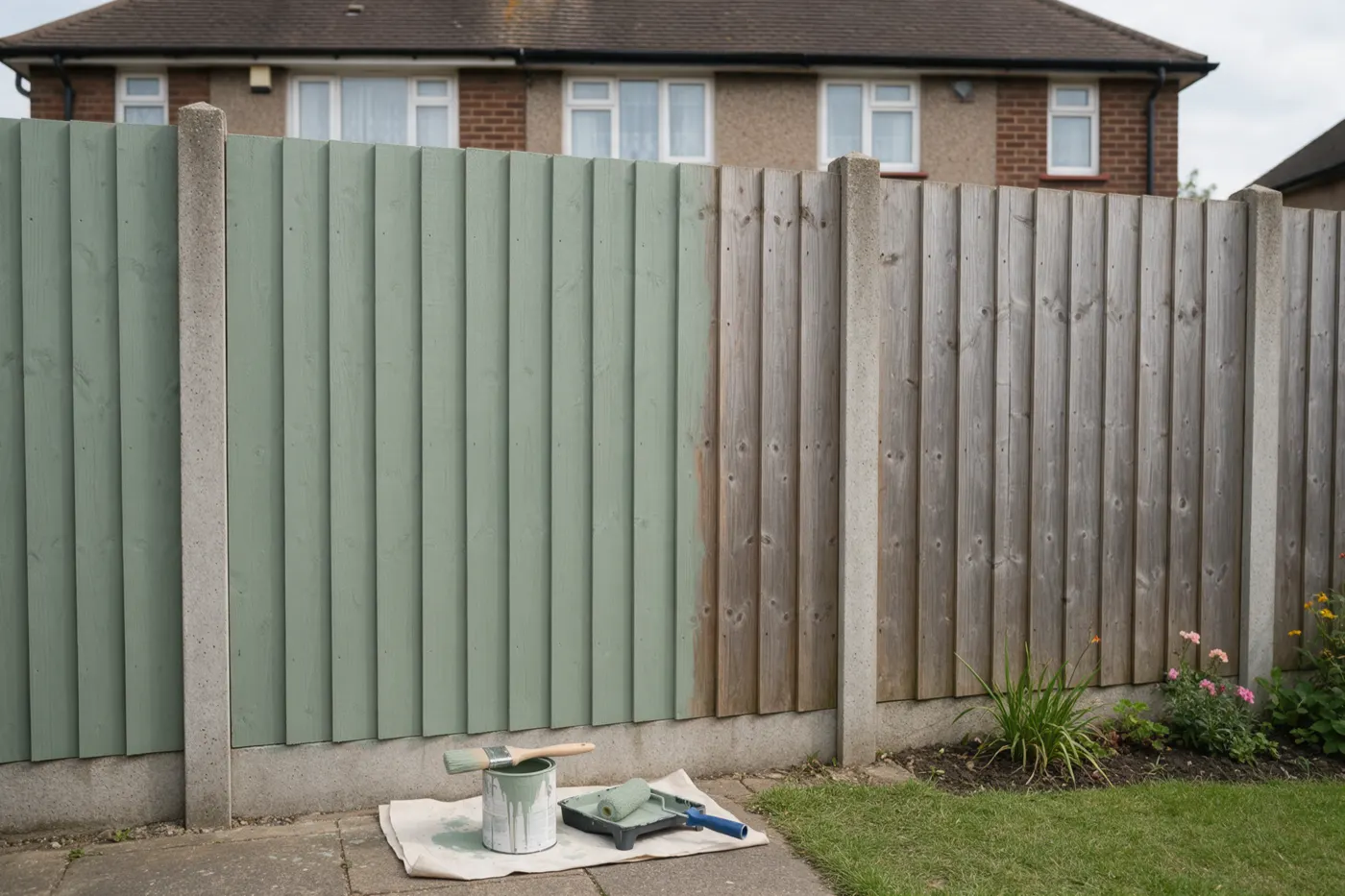
- Stir the paint well before you start and now and then as you go.
- Brush the edges and awkward bits first: round posts, the bottom edge and anywhere near plants or walls.
- Work one panel at a time, from the top down, so drips don't land on finished paint. Brush or roll along the grain: up and down on vertical boards, side to side on horizontal ones.
- Work the paint into the gaps and the rough grain, and give the top edge extra attention, as that's where water settles. For a tall fence, use an extension pole rather than stretching off a ladder.
- If you're spraying, test it on cardboard first, keep the nozzle 10 to 30cm from the fence, spray along the boards and hold a piece of cardboard above the top edge, so the spray doesn't drift onto your neighbour's side or plants. Change the angle on the second coat to catch anything you missed.
- Leave it to dry, then do the second coat the same way.
- Clean up. Water-based paint washes out of brushes with warm soapy water; oil-based needs a solvent such as white spirit. Clean a sprayer out thoroughly, or leftover paint clogs it.
Coats and drying time
Plan on two coats. You may need three to get an even, solid colour, especially over a previously dark colour. One-coat fence paints are sold too, if speed matters more than depth of colour.
Most fence paint is dry to the touch after a couple of hours, but leave 4 to 12 hours before a second coat, or 24 hours to be safe. Water-based paint dries fastest: some are touch dry in about 1 hour in dry weather. The tin is the final word for your paint.
Your neighbour's side and whose fence it is
If the fence is yours, both sides are yours to paint. If it's your neighbour's fence, Citizens Advice says (for England) that you can't make changes to your side without their permission, and gives painting it as an example. In practice that means asking first, and it's worth getting the answer in writing.
Not sure who owns it? Check the legal documents from when you bought your home, which you can buy from the Land Registry if you don't have them. Our fencing page covers the boundary question in more detail. If you rent, ask your landlord before you paint any fence.
Whoever owns it, keep drips and overspray off the far side and your neighbour's plants.
How long it lasts
Fence paint usually lasts 2 to 5 years, depending on the paint, the weather and the state of the wood underneath, and some brands claim up to 6. Repainting every few years protects the fence against rot, so you replace panels less often.
When it starts to look patchy, repaint before bare wood shows through. That's usually a brush down, a wash and a coat or two, rather than the full strip and repair.
If you'd rather pay someone
We'd ask a handyman or a painter and decorator. A handyman usually charges by the hour, so it's worth adding the shed or gate to the same visit. If the house walls or windows need doing too, an exterior painter can quote for the lot. Either way, ask who does the preparation, as that's most of the job.
What it costs
Prices, what moves them and who to hire, in our cost guides.
Free, no obligation.
Frequently asked questions
What's the best time of year to paint a fence?
Spring or early autumn, on a dry, mild day, with a few days of dry weather to follow. Check the tin for the paint's own limits; some say only above 5°C with no bad weather forecast.
Do I need to clean a fence before painting it?
Yes. Brush it down, wash it with a pressure washer or warm soapy water, kill off any algae and let it dry completely. Algae left under paint keeps growing and makes the paint peel.
Can you paint a fence after rain?
Not while it's wet: painting a wet fence can spoil the finish. Wait a day or two after rain for the wood to dry out.
How many coats does a fence need?
Usually two. You may need three for an even colour, especially over a previously dark colour. Let each coat dry before the next.
How long does fence paint take to dry?
Most fence paint is dry to the touch in a couple of hours, but leave 4 to 12 hours before a second coat, or 24 hours to be safe. Check the tin.
Can I paint my side of my neighbour's fence?
Not without asking. Citizens Advice says that in England you can't make changes to your side of a neighbour's fence, such as painting it, without their permission.
Can I paint a new fence straight away?
Usually not. New pressure-treated panels probably won't need painting at first, and should weather for a short time and be completely dry before you paint them.
How we checked this8 sources · 3 officialView sourcesHide
Rules come from the legislation and official guidance, read at source, and are linked where the guide states them. Practical advice comes from makers', trade bodies' and official guidance; where sources disagreed, we've said so. Prices aren't in our guides: they're on the cost pages linked above, each with its own sources. More on our method.
- IndustryHow to paint a fence, Wickes. Checked 25 Oct 2026.
- IndustryWhat's the best fence paint?, Wickes. Checked 25 Oct 2026.
- IndustryHow to paint a garden fence, Cuprinol. Checked 25 Oct 2026.
- IndustryCuprinol Garden Shades: product information and instructions, Cuprinol. Checked 25 Oct 2026.
- IndustryA guide on how to paint fence panels, Travis Perkins. Checked 25 Oct 2026.
- OfficialIf you disagree with your neighbour about a wall or fence (England), Citizens Advice. Checked 25 Oct 2026.
- OfficialCreosote and telegraph poles (research briefing CBP-11200), House of Commons Library. Checked 25 Oct 2026.
- OfficialLead: information for the public (published 8 October 2024), UK Health Security Agency (GOV.UK). Checked 27 Oct 2026.