The Short Answer
If one sink or toilet is slow and everything else drains fine, it's that fitting, not the drain: see our guides to unblocking a sink and a toilet. If several are backing up, or an outside grid is overflowing, it's the drain. Here's what to do:
- Ask the neighbours. If they have the same problem, it's probably a shared sewer: call your water company.
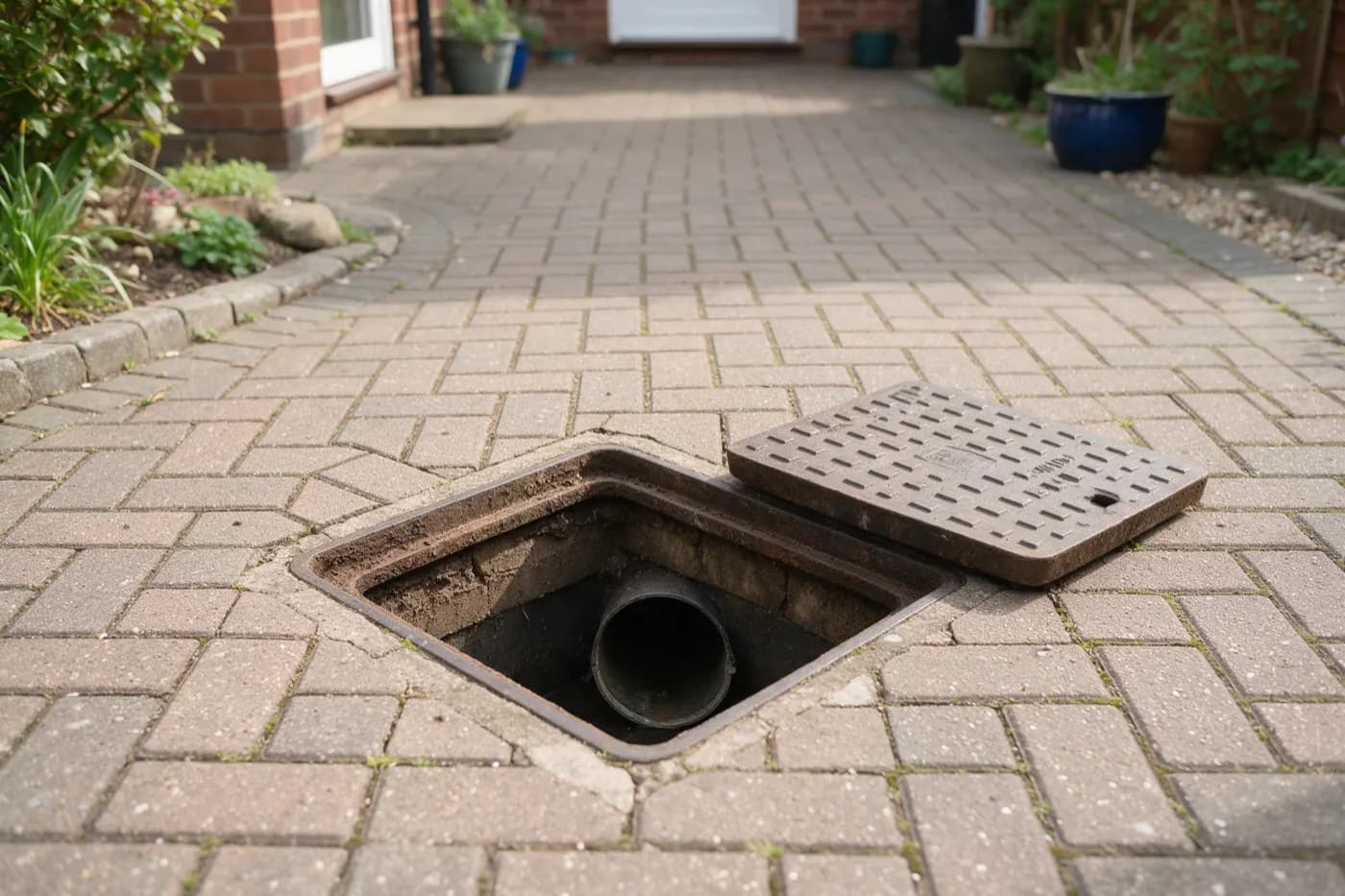
- Lift the manhole covers. A full chamber means the blockage is further down; an empty one means it's further up.
- Clear what you can reach by hand, with heavy gloves, then try a hose.
- Use drain rods, always turning them clockwise.
If that doesn't shift it, or sewage is coming up, call a drain engineer, or the water company if it's their pipe.
Lift the manhole covers before anything else.
The water level in each chamber tells you where the blockage is: a full chamber means it's further down from there, an empty one means it's further up. Start with the chamber nearest the house and work towards the road.
If sewage has come up outside, keep children and pets away from it, and wash your hands and your shoes afterwards.
Is it the drain, or just one sink?
Every sink, bath, shower and toilet has its own trap and waste pipe, and they all join up in the drain under or beside the house. So:
- One fitting slow, the rest fine: the blockage is in that fitting's trap or pipe. Start there.
- Several fittings slow, gurgling, or water rising in a sink or toilet when another empties: the drain is blocked further down.
- Upstairs affected but downstairs working: Thames Water says that points to a blockage inside the house, in the pipes before the drain.
- A bad smell from the drains is another sign.
Is it yours to clear?
Before you pay anyone, work out whose pipe it is. In England and Wales, you're responsible for the drains inside your boundary that only serve your home. Your water company is responsible for pipes outside your boundary, pipes shared with a neighbour, and the sewers (Citizens Advice; Welsh Water says the same for Wales). Roadside drains and gullies are the council's: report a blocked one on GOV.UK.
The quickest test is the neighbours. If they're having the same problem, call the water company. Even if they aren't, the water company can tell you whose pipe it is. Southern Water warns not to pay a private firm to clear a shared sewer: they aren't allowed to work on public sewers. Our blocked drain cost page has more on who pays.
If you rent in England, it's your landlord's job to repair drains, though Shelter says you can be charged for a blockage you caused, such as flushing nappies. Tell them early.
Find the blockage: lift the manhole covers
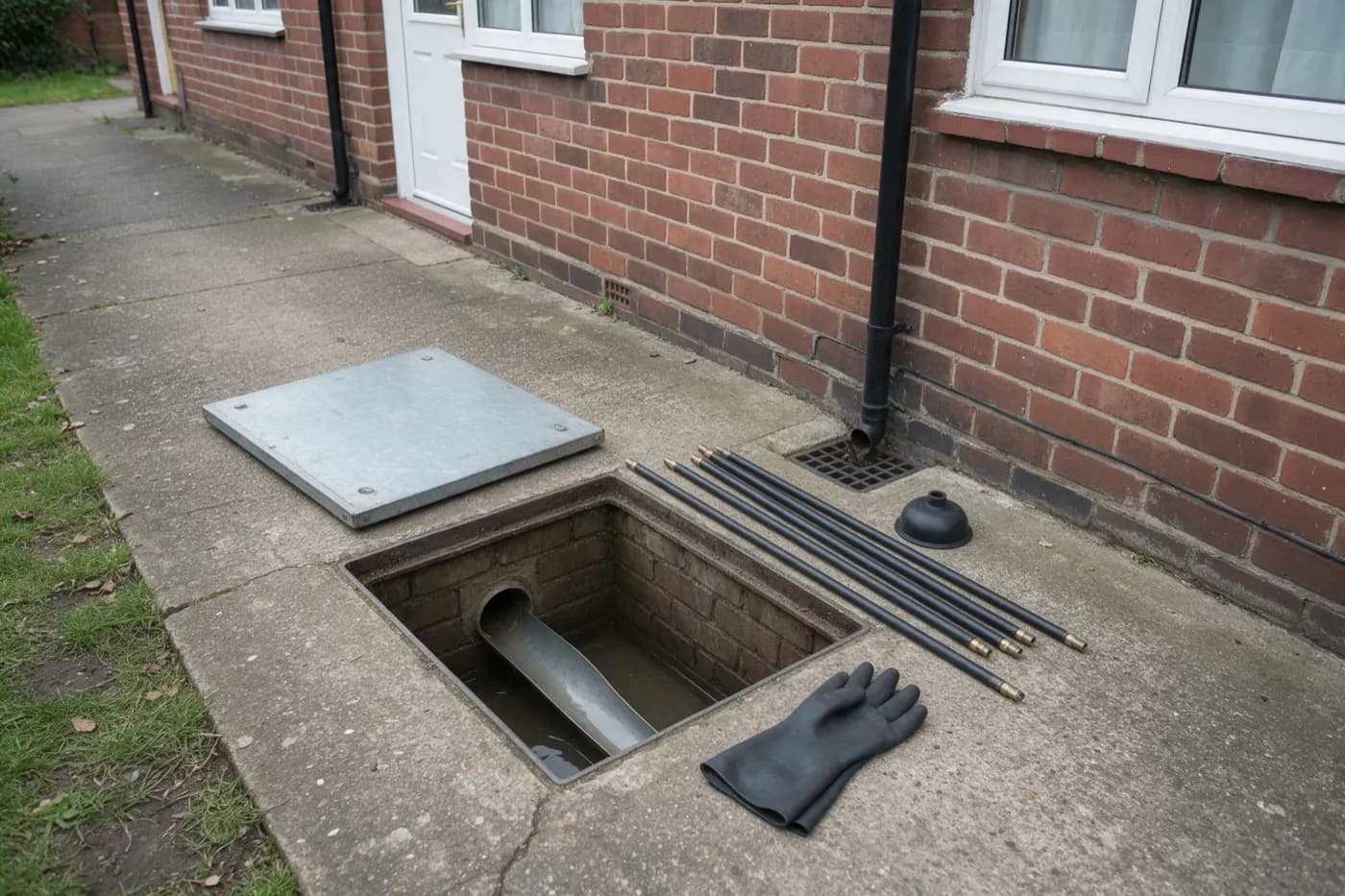
If your drain has manholes (inspection chambers) with covers you can lift, the water level in each tells you where the blockage is:
- Full of water: the blockage is further down, after this chamber.
- Empty or flowing: the blockage is further up, between this chamber and the house.
Work along from the house towards the road. The blockage is between the last full chamber and the first empty one, so that's where you work. If the last chamber inside your boundary is full, the blockage may be beyond it, in pipe that's usually the water company's: call them before going further. Thames Water adds that if the chamber is clear, the blockage is probably inside your home.
How to clear it
Wear long drain or pond gloves (or several heavy-duty bin bags over your arm, up to the shoulder) and eye protection, and keep children and pets away. Then, in this order:
- By hand. Reach into the full chamber and pull out what you can. Work from the upstream side if you can, so you don't pack the blockage tighter. A long-handled slotted spoon helps you reach further.
- With a hose. Push a garden hose as far into the pipe as it will go, pack the opening with old towels so the pressure builds, and run it on full for about 10 seconds. If that hasn't cleared it, it isn't going to.
- With drain rods. Fit the plunger head, bend the rod into the pipe and push it along, adding lengths as you go. Always turn the rods clockwise: turning them the other way unscrews the joints, and you can lose a rod inside the drain. Feed them gently round bends. If the plunger won't shift it, swap to the corkscrew head to break it up.
When it clears, run plenty of water through to make sure the blockage has gone, not just moved further along. Wash your hands, and wash your gloves and shoes too if there was sewage.
A blocked gully (the grid outside)
A gully is the grid outside where a downpipe or a waste pipe from the kitchen or bathroom runs into the drain. Under the grid is a water trap that keeps drain smells in. They block with leaves, mud, silt and food waste.
Lift the grid and, with gloves on, scoop the leaves, mud and silt into a bucket. Many newer gullies have a removable inner sleeve you can lift out to clean. Then run a hose in to check it flows. If it still backs up, the blockage is in the drain beyond it, so check your manholes.
A P-trap gully (the simpler U-bend type) can't be rodded through its trap unless it has a rodding eye: that's a job for a drain engineer. A blocked gully in the road or pavement is the council's. Often it's just leaves over the grate, which you can sweep aside if it's safe to.
What to pour down a drain (and what not to)
For an outside drain, rods and a hose do more than anything you pour in. Chemicals are for a drain that's still draining slowly, and they work best on fat and grease and much less on anything else.
- Soda crystals or caustic soda: bail the water out first, so it reaches the blockage, then follow with hot water from the kettle. Caustic soda burns skin and eyes, so wear gloves and goggles. If it splashes, rinse with lukewarm water for at least 10 to 15 minutes and get medical advice (UK Health Security Agency).
- A shop-bought drain unblocker: follow the label, leave it for the time it says, then flush with plenty of water.
- Never pour motor oil or paint down a sink or into a rainwater drain. Many rainwater drains run straight to rivers and the sea.
When to call someone
We'd call a drain engineer (or the water company, if it's their pipe) when:
- sewage is backing up into an outside drain or into the house;
- several drains are slow, or overflow in light rain;
- rods and a hose haven't shifted it;
- it keeps coming back. That can mean a collapsed or damaged pipe or roots getting in, which takes a drain engineer's equipment to find.
Get more than one quote. Some home insurance includes drainage cover, so check your policy before you book. Prices for rodding, jetting and camera surveys are on our blocked drain cost page. A blocked pipe inside the house is a job for a plumber: see plumbing repair costs.
Stopping it happening again
- Fat, oil and grease in the bin, not the sink: let it cool in a container first. Coffee grounds and food scraps too.
- Only flush pee, poo and toilet paper. Wipes (even ones labelled flushable), sanitary products, nappies and cotton buds go in the bin.
- Keep leaves off the grids, especially in autumn, and fit a grate or mesh to outside drains.
- Clear your gutters a couple of times a year, so less washes into the gullies.
What it costs
Prices, what moves them and who to hire, in our cost guides.
Free, no obligation.
Frequently asked questions
How do I know if my drain is blocked?
Look for several sinks, baths or toilets draining slowly, gurgling noises, water rising in one fitting when another empties, a bad smell, or water standing in an outside grid or manhole.
Who is responsible for a blocked drain?
In England and Wales, you're responsible for drains inside your boundary that only serve your home. The water company is responsible for pipes outside your boundary, pipes shared with a neighbour, and sewers. The council looks after roadside drains and gullies. If your neighbours have the same problem, call the water company.
Will drain rods go round bends?
Yes: feed them in gently round bends and keep turning them clockwise. Turning them the other way loosens the joints, and a rod can come off inside the pipe.
Can I unblock a drain myself?
Often, if it's your own drain and you can reach it from a manhole: clear what you can by hand, try a hose for about 10 seconds, then use rods turned clockwise. Call a drain engineer if sewage is coming up, it won't shift, or it keeps blocking.
Can a blocked drain clear itself?
Don't count on it. A full chamber or water backing up means something is stopping the flow, and it needs clearing before sewage comes up. If it keeps happening, the cause needs finding.
Does home insurance cover blocked drains?
Some policies include drainage cover, so check yours before booking anyone. If the blockage is in a shared sewer or beyond your boundary, it's usually the water company's to clear.
How we checked this11 sources · 4 officialView sourcesHide
Rules come from the legislation and official guidance, read at source, and are linked where the guide states them. Practical advice comes from makers', trade bodies' and official guidance; where sources disagreed, we've said so. Prices aren't in our guides: they're on the cost pages linked above, each with its own sources. More on our method.
- OfficialWho is responsible for repairing drains and sewers (England), Citizens Advice. Checked 16 Oct 2026.
- IndustrySewer responsibilities, Dŵr Cymru Welsh Water. Checked 2 Nov 2026.
- IndustryWhat to do when you have a blocked drain, Southern Water. Checked 2 Nov 2026.
- IndustryBlockages and blocked drains, Thames Water. Checked 27 Oct 2026.
- OfficialReport a blocked drain, GOV.UK. Checked 2 Nov 2026.
- OfficialDrainage and flooding, Cheshire West and Chester Council. Checked 2 Nov 2026.
- IndustryHow to unblock an outside drain, Wolseley. Checked 2 Nov 2026.
- IndustryHow to unblock drains outside (5 January 2026), Jeyes Fluid. Checked 2 Nov 2026.
- IndustryWhat are gullies, and where do you need them?, JDP. Checked 2 Nov 2026.
- OfficialSodium hydroxide: general information (updated 28 November 2024), UK Health Security Agency. Checked 27 Oct 2026.
- IndustryLandlord and tenant responsibilities for repairs (updated 27 October 2025), Shelter England. Checked 27 Oct 2026.