The Short Answer
A toilet that keeps running usually has one of two faults inside the cistern, or a sticking flush button. Lift the lid and look at the water against the top of the overflow tube:
- Up to or over the top of the overflow: the fill valve isn't shutting off. Lower the float, clean the valve, or replace it.
- Below the overflow, with the button fully up, but still trickling into the bowl: the flush valve isn't sealing. Clean or replace its rubber seal.
- The button stays down: free the button.
These are often DIY fixes. Don't leave it: a leaking toilet can waste up to 400 litres of water a day.
It's the flush valve: water is getting past its seal.
First make sure the flush button has come fully back up: a button that sticks holds the valve open. Then turn the water off and flush to empty the cistern. Check the rubber seal at the base of the flush valve: clean off any limescale or debris, and replace the seal if it's worn or misshapen, or won't come clean.
A new seal often fixes it. If it doesn't, replace the flush valve.
Turn the water off at the isolating valve on the pipe to the cistern, or at the stop tap if there isn't one. A little water movement just after a flush is normal; a steady trickle isn't.
How a cistern works, and what goes wrong
There are two valves inside the cistern:
- The fill valve lets water in from the supply pipe. A float rises with the water and shuts the valve off when the cistern is full.
- The flush valve lets the water out into the pan when you flush. A rubber seal at its base holds the water in the rest of the time.
If the water gets too high, an overflow takes it away. In England and Wales, the water fittings regulations require a toilet's flushing cistern (other than a pressure flushing cistern) to have a warning pipe, an overflow that discharges where you can see it, or something no less effective. On many older cisterns that's a pipe out through the wall. Modern cisterns, especially push-button ones, usually overflow into the pan instead, through a tube inside the cistern, which is why their leaks are easy to miss.
So a running toilet is usually one of two things: the fill valve isn't stopping, so water rises over the overflow, or the flush valve isn't sealing, so water seeps past it and the cistern keeps topping itself up. Worn seals, limescale and debris are the usual causes of both. Now and then it's a flush button that sticks down.
Find the fault in two minutes
- Look and listen. Between flushes, watch the back of the bowl for trickling or rippling water, and listen for a trickle or a faint hiss as the cistern refills.
- Lift the lid. On a toilet with a hidden cistern, take off the flush plate or button panel instead.
- Check the button. If it stays down after a flush, it's holding the flush valve open: start there.
- Find the water level. If it's up to or over the top of the overflow tube, it's the fill valve. If it's below, the button is fully back up and the toilet is still running into the bowl, it's the flush valve.
A little water movement just after a flush is normal. A steady trickle isn't.
If it's the fill valve
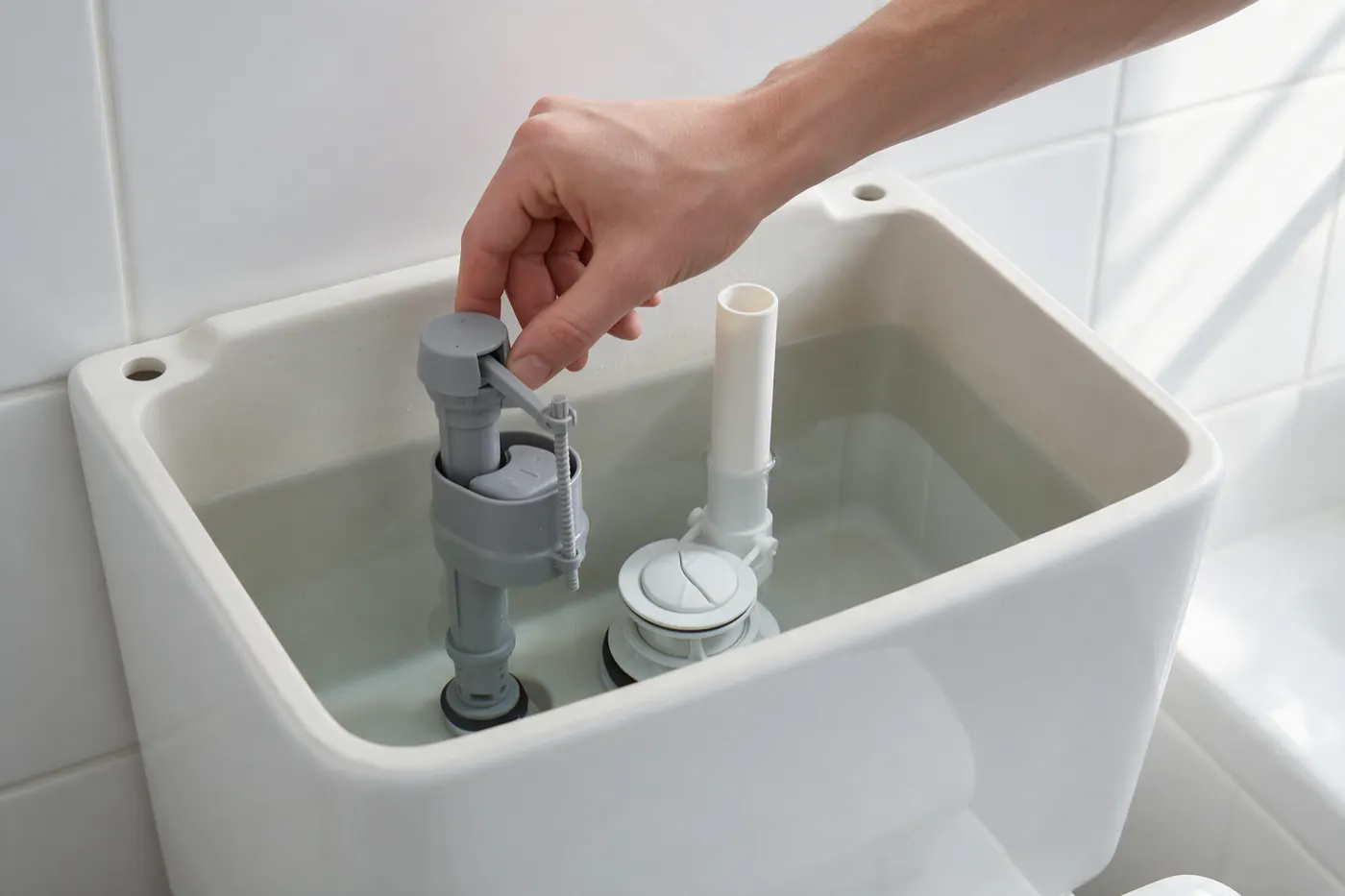
First turn the water off at the isolating (servicing) valve on the pipe to the cistern, behind or beside the toilet: the regulations ask for one next to every toilet cistern. If yours hasn't got one, use the stop tap, which is usually under the kitchen sink (sometimes in a cellar or garage): turn it clockwise.
- Lower the float. The water should settle about 25mm to 50mm below the top of the overflow. On an older ball-and-arm valve there's an adjusting screw where the arm meets the valve. On a modern valve the float is a cup on the valve's shaft, set by a clip or a screw. Which way the screw turns varies between valves, so make a small change, turn the water back on, flush and check.
- Check the float moves freely and isn't catching on anything.
- Clean it. Limescale and debris can stop a valve shutting off. Clean it as the maker's instructions describe, rather than taking it apart beyond the parts meant to come off.
- Replace it if it still won't shut off.
Buying a new one: note whether the supply pipe comes in at the bottom of the cistern or the side, and the size of the thread. Some universal fill valves can be set up for bottom or side entry and for more than one thread size, and their height adjusts. We'd take the old valve, or a photo of it, to the merchant.
If it's the flush valve
Turn the water off and flush to empty the cistern. Then:
- Check the rubber seal at the base of the flush valve. Clean off limescale or grit with white vinegar or a mild descaler.
- Replace the seal if it's worn or misshapen, or won't come clean. It's a simple job and often fixes it.
- Replace the flush valve if a new seal doesn't stop the trickle.
Water dripping from the overflow pipe outside
An overflow pipe through the bathroom wall is the warning pipe doing its job: it's placed so you'll see the water. If it's the toilet's, the water in the cistern is reaching the overflow, so it's the fill valve: lower the float, then clean or replace the valve as above.
It isn't an emergency, but don't leave it: it's clean water you may be paying for. Make sure the pipe really is the toilet's: a cold water storage cistern must have an overflow pipe too.
When to call a plumber
A running toilet can often be fixed with an adjustment or a new part. We'd call a plumber if:
- you can't turn the water off at the toilet or the stop tap;
- the cistern is hidden and you can't get to the valves;
- it still runs after a new seal and a new fill valve;
- the water is coming out under the cistern or at a joint, which is a leak rather than a running toilet.
You can ask local plumbers to quote with the form below. For what it costs, see plumbing repair costs and plumber rates. If the toilet itself is old or cracked, it may be time for a new one: see toilet installation costs.
Why it's worth fixing now
Up to 1 in 20 toilets leak, some losing up to 400 litres a day: as much as a household of 3 uses. (One person uses about 140 litres a day.) If you're on a water meter, you pay for every litre of it.
What it costs
Prices, what moves them and who to hire, in our cost guides.
Free, no obligation.
Frequently asked questions
How do you fix a toilet that keeps running?
Lift the cistern lid and look at the water. If it's up to or over the top of the overflow tube, lower the float on the fill valve so the water settles about 25mm to 50mm below it, then clean or replace the valve if it still runs. If the button stays down, free it. If the water is below the overflow, the button is fully back up and it's still trickling into the bowl, clean or replace the flush valve's rubber seal.
Why is water constantly trickling into my toilet bowl?
Either the flush valve's seal isn't sealing, or the water is rising too high and running down the overflow tube into the pan. Check the level against the top of the overflow: over it means the fill valve; below it, with the flush button fully back up, means the flush valve seal.
Why does my toilet refill on its own every few minutes?
Water is slowly escaping from the cistern, past the flush valve's seal or down the overflow, and the fill valve tops it back up. Check the water level against the overflow first, then the seal. For a silent leak, try the toilet paper test: a square at the back of the dry pan overnight comes up wet if it's leaking.
Is it bad if my toilet keeps running?
It wastes water: a leaking toilet can lose up to 400 litres a day, as much as a household of 3 uses. On a water meter, you pay for it.
Will a running toilet stop on its own?
Don't count on it. A worn seal, limescale or a float set too high won't put themselves right.
Can I fix a running toilet myself?
Often, yes, if you can turn the water off: adjusting the float, cleaning a valve, and fitting a new flush valve seal or fill valve. Call a plumber if you can't isolate the water, can't get to a hidden cistern, or it still runs after new parts.
Is a dripping overflow pipe an emergency?
No, but don't leave it. If the pipe is the toilet's, the water in the cistern is reaching the overflow, which means the fill valve needs adjusting, cleaning or replacing.
Which fill valve do I need?
Check whether the supply pipe enters the cistern at the bottom or the side, and the size of the thread. Some universal fill valves can be set up for bottom or side entry and for more than one thread size, and their height adjusts. Take the old one, or a photo of it, to the merchant.
How we checked this1 source · 1 officialView sourcesHide
Rules come from the legislation and official guidance, read at source, and are linked where the guide states them. Practical advice comes from makers', trade bodies' and official guidance. Prices aren't in our guides: they're on the cost pages linked above, each with its own sources. More on our method.
- OfficialThe Water Supply (Water Fittings) Regulations 1999, Schedule 2 (WC flushing, drinking water taps), legislation.gov.uk. Checked 15 Oct 2026.